
Cumberland County Property Tax Records
Cumberland County property tax records are maintained by the Commissioner of the Revenue and the Treasurer, both located in Cumberland Court House in central Virginia. These records are public documents under Virginia law, and any person can access them to find assessment values, ownership information, and tax payment status for parcels throughout the county without needing to provide a reason or have a direct interest in the property. Each record includes the owner name, parcel identification number, land and improvement values, and tax payment history. Assessment data shows both current values and any changes made following sales, new construction, or appeals in Cumberland County.
Cumberland County Overview
Commissioner of the Revenue
The Cumberland County Commissioner of the Revenue assesses all real property in the county at fair market value as required by Virginia Code § 58.1-3200. The Commissioner's office maintains a parcel-level record for every piece of real estate in the county, covering the current owner's name, parcel identification number, legal description, acreage, land value, improvement value, and assessment history. These records are the foundation of the county's annual real estate tax levy.
Cumberland County is a rural central Virginia county with a mix of agricultural land, timber tracts, and rural residential properties. The Commissioner applies appropriate valuation methods to each property type. Farm and forest land that qualifies for use-value assessment under state law can be assessed based on its productive capacity rather than its potential sale price in a subdivided or developed state. This program can significantly reduce taxes on qualifying agricultural land. Contact the Commissioner's office to ask about use-value assessment eligibility and application deadlines.
When a property in Cumberland County sells, the deed is recorded at the Circuit Court and the Commissioner updates the ownership record and reviews the assessed value. Staff at the Commissioner's office can explain how any particular parcel was assessed and what comparable sales data was used. The office is located at the county courthouse in Cumberland Court House and follows a standard business-hour schedule.
Under § 58.1-3330, property owners receive written notice if a reassessment increases their value above a set threshold. That notice provides information about the appeal process and the applicable deadlines. Responding to such a notice promptly is important because appeal windows close under state-set timelines.
Cumberland County Treasurer
The Cumberland County Treasurer collects real estate taxes and personal property taxes based on values set by the Commissioner of the Revenue. The office generates bills and processes payments made by mail, in person at the courthouse, or through any online payment option currently offered by the county. Check the county's website at cumberlandcounty.virginia.gov for current due dates and payment methods before the payment deadline arrives.
The Treasurer's records are public and show whether taxes on any given parcel are current or delinquent. Under Virginia law, unpaid real estate taxes become a lien on the property. This means any title search conducted before a real estate sale will include a check of Treasurer records to confirm no outstanding tax liabilities. The Treasurer can issue a certificate confirming tax status for any parcel, and this document is commonly required by lenders and title companies as part of a closing. Delinquent taxes must be resolved before a clean deed can transfer.
For questions about why a tax bill changed, the Commissioner's office is the starting point since they control the assessed value. For payment receipts, delinquency status, or balance inquiries, the Treasurer handles these directly. In a smaller county like Cumberland, office staff often know local parcels well and can direct you quickly to the right information.
The following image shows the Cumberland County official government website, which provides links to both the Commissioner and Treasurer departments.

Both offices are accessible through the county's website at cumberlandcounty.virginia.gov.
How to Search Property Records
Visit the Cumberland County website at cumberlandcounty.virginia.gov to see if an online property assessment portal is available. Some Virginia counties contract with software vendors who provide public-facing search tools. If such a tool is active for Cumberland County, you can search by owner name, parcel ID, or street address and view assessment data without making the trip to Cumberland Court House in person.
If no online portal is available, contact the Commissioner of the Revenue's office directly. Under Virginia Code § 58.1-3331, all assessment records must be open for public inspection at the county's offices during regular business hours. You do not need to state a reason or show any legal interest in the parcel. Staff can look up records at the counter, and copies are available for a small copying fee. In-person visits are often most efficient for rural parcels that may not appear in online databases.
The Circuit Court Clerk's office in Cumberland Court House holds deed records and plats that supplement assessment files. Together, Commissioner records and Circuit Court deed records provide a complete picture of a parcel's ownership and value history. Virginia's FOIA process is also available if you need records in bulk or in a specific format.
Assessment Process
All real property in Cumberland County must be assessed at 100 percent of fair market value as required by § 58.1-3200. The Commissioner uses comparable sales, property inspections, and parcel characteristics to estimate what each property would bring in an arm's-length market sale. Fair market value is defined as what a willing buyer would pay a willing seller with no compulsion on either side and both parties fully informed about the property.
General reassessments must occur at least every six years under Virginia law. Between those cycles, the Commissioner's office updates individual parcels when changes occur, such as a sale, new construction, demolition, or subdivision. This keeps the tax roll reasonably accurate across the full reassessment cycle without waiting for the next formal general reassessment. In a rural county like Cumberland, where market transactions are less frequent, individual updates are especially important for keeping values current.
If you think your assessed value is too high, start by talking to the Commissioner's office and reviewing the data that was used. If informal resolution fails, file an appeal with the Board of Equalization under § 58.1-3378. The Board holds hearings under § 58.1-3379 and can lower the assessment if you present credible evidence. A recent independent appraisal is often the strongest type of evidence to bring to a Board hearing.
The following image is from the Virginia real property assessment statutes page, which governs how Cumberland County conducts its assessment process.
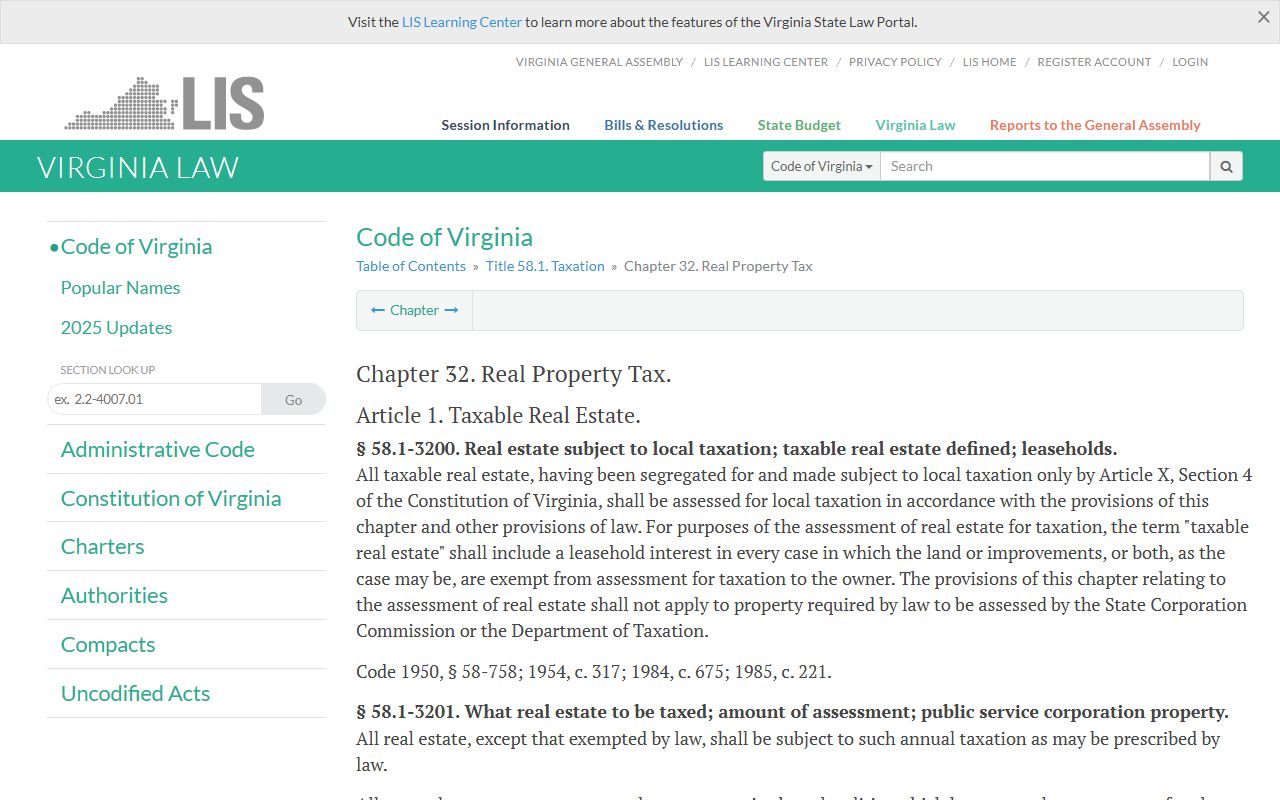
These statutes at law.lis.virginia.gov set the legal standard that Cumberland County must follow for all property assessments.
Tax Relief Programs
Cumberland County administers a real estate tax relief program for elderly and disabled homeowners under Virginia Code § 58.1-3210. Eligible residents who own and occupy their home as a primary residence and who meet the county's income and age thresholds can receive a partial or full exemption from real estate taxes. The Commissioner of the Revenue administers applications. Contact the office to get current eligibility limits and the application form. Applying before the county's annual deadline is essential to have the relief reflected in that year's tax bill.
Veterans with a 100 percent total and permanent disability rating from the Department of Veterans Affairs are entitled to a full real estate tax exemption on their primary home under § 58.1-3219.5. The surviving spouse of a qualifying veteran may also continue to receive the exemption subject to conditions set by state law. To apply, bring your VA disability letter and proof of property ownership and primary residency to the Commissioner's office in Cumberland Court House.
For additional support, the Virginia Department of Housing and Community Development at dhcd.virginia.gov offers housing assistance programs that may help qualifying low-income homeowners manage property tax costs. Check the DHCD website for current program availability and eligibility criteria.
Land Books and Records
The Commissioner of the Revenue maintains Cumberland County's land book as required by Virginia Code § 58.1-3301. The land book is a comprehensive listing of every parcel of real property in the county, the owner's name, and the assessed value for the current tax year. It is a public record open for inspection at the Commissioner's office without charge, though copying fees apply. Historical land books may be archived at the county courthouse or through the Library of Virginia.
Land books are a useful research tool for anyone studying property ownership history in Cumberland County. Because the county has significant amounts of agricultural and timber land that has been held in family ownership for generations, land book records can trace a parcel's history over many decades. Comparing entries from different years reveals when ownership changed and how assessed values shifted through successive reassessment cycles. Title researchers often use land books alongside deed records from the Circuit Court to build a complete ownership history for rural parcels.
Under § 58.1-3331, all assessment records including the land book must remain open to public inspection. Anyone can review land book entries for any parcel in Cumberland County by visiting the Commissioner's office during regular business hours.
Cities in Cumberland County
Cumberland County has no independent cities within its boundaries. The county seat of Cumberland Court House is an unincorporated community. Nearby cities with their own property tax systems include Richmond to the east.
Nearby Counties
Cumberland County borders several counties in central Virginia. Property near these county lines may benefit from checking records in adjacent jurisdictions.