
Find Property Tax Records in Amelia County
Amelia County property tax records are kept by the Commissioner of the Revenue and the Treasurer, both based at the county seat in Amelia Court House. The county sits in central Virginia as part of the Richmond metropolitan area, and its tax records cover residential, agricultural, and commercial real estate throughout the county. This page explains how to access assessment data, understand your tax bill, and find relief programs available to qualifying Amelia County property owners.
Amelia County Overview
Commissioner of the Revenue
The Amelia County Commissioner of the Revenue assesses all real estate and tangible personal property in the county. Virginia's § 58.1-3200 requires that real property be assessed at 100% of fair market value, and the Commissioner's office carries out that function for all parcels within Amelia County. The office maintains records for each parcel, including the owner's name, the property's legal description, land and building values, and the assessed value history.
When a property is sold in Amelia County, the deed recorded at the Circuit Court clerk's office triggers an update in the Commissioner's ownership records. New construction, additions, or demolitions also prompt record updates. The Commissioner reviews property data on a regular cycle to keep assessments current. If you've made major improvements to your property, expect those to show up in your next assessment cycle once permits and inspections are on record with the county.
The Commissioner administers tax relief programs for qualifying residents under state law. These programs include relief for elderly and disabled homeowners and exemptions for disabled veterans. Applications are handled at the Commissioner's office, and staff can walk you through the eligibility criteria and paperwork. The Amelia County government website provides contact information for both offices.
Amelia County Treasurer
The Amelia County Treasurer collects real estate taxes, personal property taxes, and other locally assessed charges. Tax bills are generated based on assessments from the Commissioner's office and sent to property owners on the county's billing schedule. The Treasurer accepts payments in person at the courthouse, by mail, and online where services are available.
The Treasurer's records show current tax status for any parcel in the county. If you need to confirm whether taxes are paid on a property you're considering buying, the Treasurer's office is the right place to check. Delinquent taxes are a lien on the property and don't go away when the property changes hands unless specifically addressed in the transaction. Clearing delinquent taxes before closing protects both buyers and sellers.
Interest accrues on late tax payments, and Amelia County may pursue collection action for long-delinquent accounts. The Treasurer can tell you the current balance owed on any parcel, including principal, interest, and any applicable fees. Payment plans may be available for owners facing financial hardship, though this varies by year and county policy.
How to Find Amelia County Property Records
Start your search at ameliacountyva.gov, where you can find links to both the Commissioner and Treasurer department pages. Check the Commissioner's page for any online assessment search tool. Some Virginia counties offer searchable property databases through their websites; others require in-person or phone requests. If an online option is available in Amelia County, you can typically search by owner name, parcel number, or address.
Virginia Code § 58.1-3331 makes assessment records open to public inspection. You do not need a legal interest in a property or a stated reason to view records at the Commissioner's office. Walk-in visits are generally welcome during business hours, and staff can print copies of assessment records for a small fee. For complex or large-scale requests, submitting a written FOIA request gives the county up to five business days to respond.
The Amelia County Circuit Court clerk's office holds deeds, plats, and other instruments that document property ownership and transfers. Cross-referencing deed records with assessment data from the Commissioner gives you the full picture of a parcel's history. The clerk's office is also in Amelia Court House and can be reached through the county's main website.
Assessment Process and Appeals
Real estate in Amelia County is assessed using methods consistent with Virginia's mass appraisal standards. The Commissioner's office analyzes market sales data to set values for groups of similar properties. Agricultural land, which makes up much of Amelia County's area, is valued based on land use and productivity in addition to market factors. Residential properties are typically compared to recent sales of similar homes in the county or nearby markets.
Property owners who want to check their assessment data can request to view their appraisal card under § 58.1-3332. The card shows what characteristics the assessor has on record for the property, including lot size, building dimensions, condition, and special features. If you find errors, bringing documentation to the Commissioner's office can lead to a corrected value without a formal appeal.
Formal appeals go to the Board of Equalization, which is appointed by the Circuit Court and operates independently under § 58.1-3378. Property owners present evidence that their assessed value is too high relative to fair market value, and the board can adjust the assessment based on what the evidence shows. Procedures for these hearings are set out in § 58.1-3379. After the board decides, Circuit Court appeal is still available for those who remain dissatisfied.
The image below shows the Virginia real property tax assessment framework, which governs how Amelia County and all Virginia localities must assess real estate.
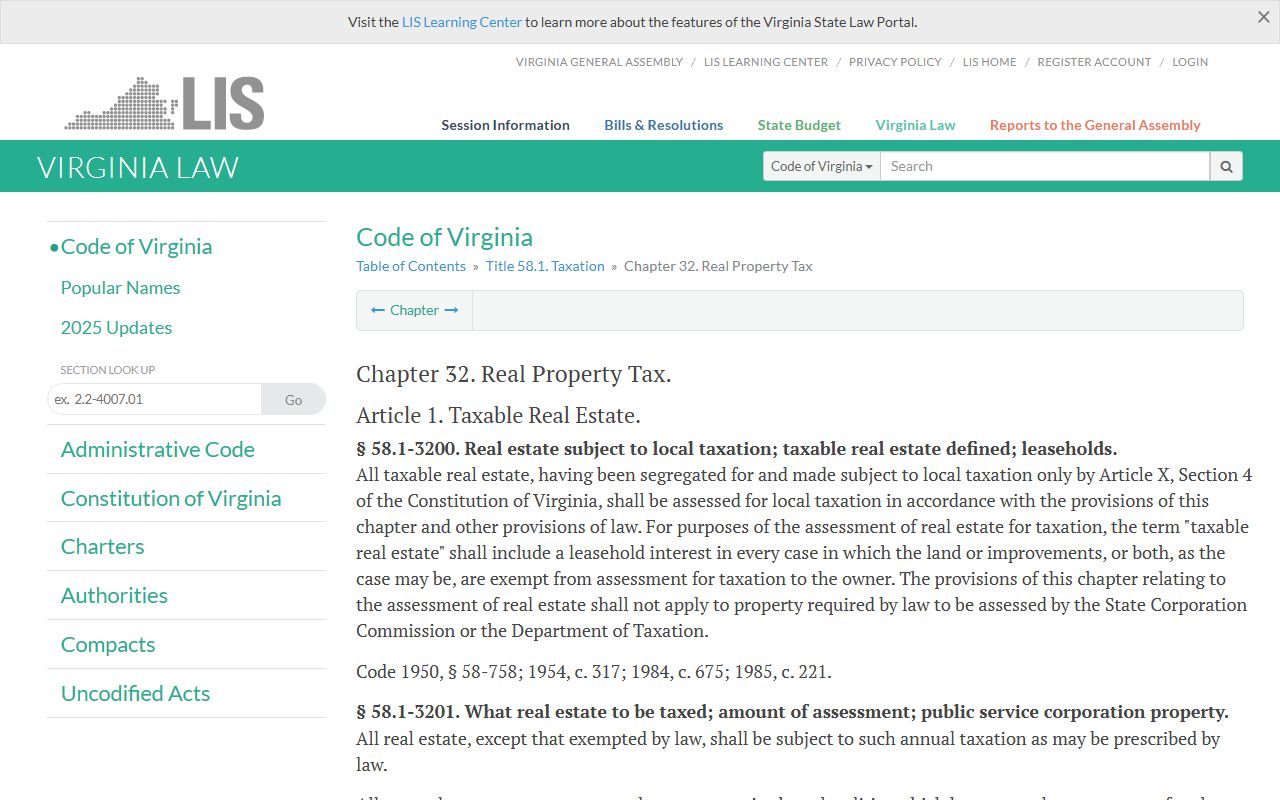
Virginia Code Chapter 32 sets the legal foundation for real estate assessment in Amelia County, including the 100% fair market value requirement.
Tax Relief Programs
Amelia County offers real estate tax relief for elderly and disabled residents under Virginia Code § 58.1-3210. Qualifying residents who own and occupy their home as a primary residence may receive a reduction or exemption from their real estate tax bill. Eligibility depends on meeting age or disability criteria and staying within income and net worth limits set by the county board of supervisors. These thresholds are reviewed annually, so check the Commissioner's office for the most current figures.
Veterans with total and permanent service-connected disabilities are eligible for a full exemption from real estate taxes on their primary residence under § 58.1-3219.5. Surviving spouses of veterans killed in action can also qualify. A disability rating certification from the U.S. Department of Veterans Affairs is required. The Commissioner's office handles these applications and can explain exactly what documentation is needed for Amelia County's process.
The Virginia Department of Housing and Community Development administers several state programs that may provide additional help for homeowners in Amelia County. These can include mortgage assistance, housing repair programs, and resources for homeowners facing financial hardship. Checking with DHCD alongside the county's own programs gives you the most complete picture of what help is available.
Land Books and Record Access
Virginia Code § 58.1-3301 requires the Commissioner of the Revenue in every Virginia county to maintain a land book listing all taxable real property, the owner of record, and the assessed value. Amelia County's land book is a public record available for inspection during office hours. It provides an authoritative snapshot of property ownership and values, useful for title research and property due diligence.
Historical land books for Amelia County may be available at the Circuit Court clerk's office or through the Library of Virginia, which preserves historical records from across the state. For current records, the Commissioner's office is the right place to start. The clerk's office holds recorded deeds and plats that can help trace the ownership history of any parcel in the county.
The image below shows the Virginia Code's land book requirement, which applies to all Virginia counties including Amelia and ensures that property tax records remain a matter of public record.
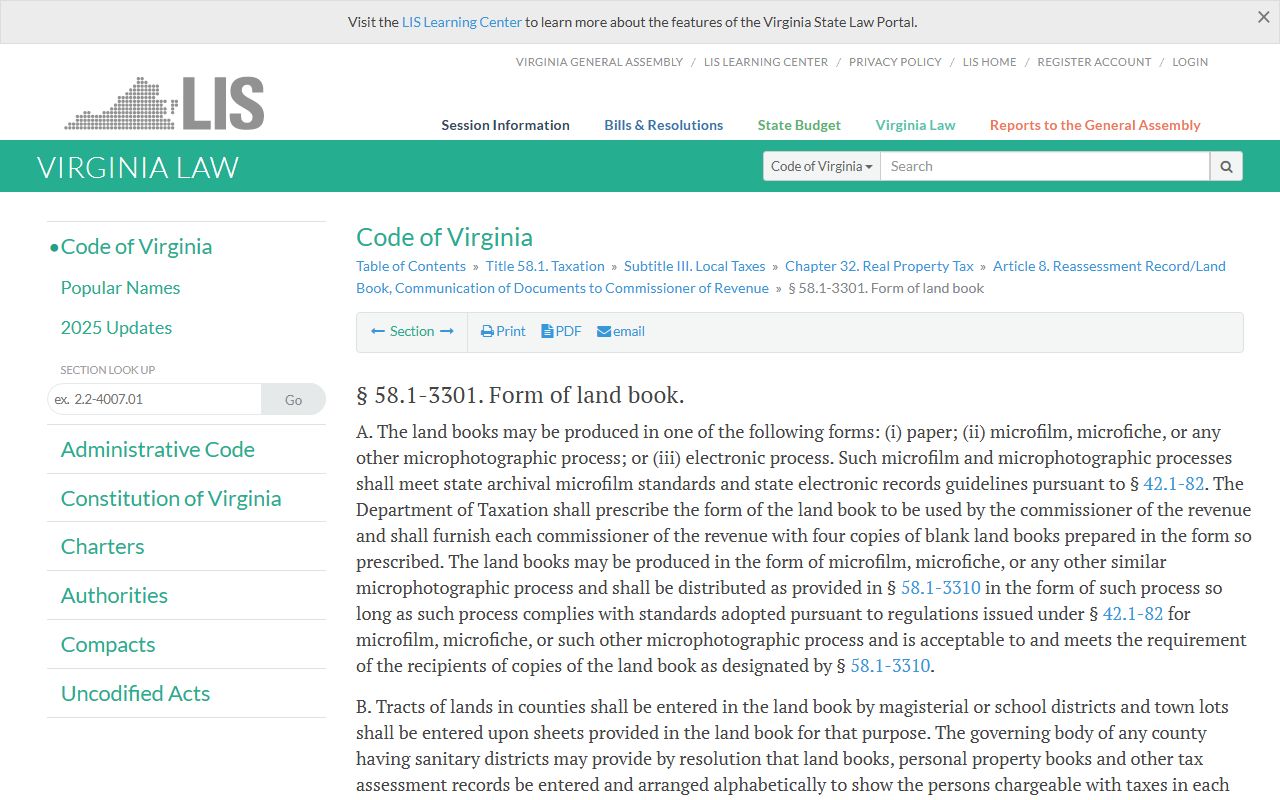
Land books maintained under § 58.1-3301 make Amelia County property tax data accessible to any member of the public who needs it.
Cities in Amelia County
Amelia County does not contain any independent cities. The county seat, Amelia Court House, is an unincorporated community rather than an incorporated city or town.
Nearby Counties
Amelia County is located in central Virginia, bordered by several counties that are part of the greater Richmond area. Select a neighboring county to view its property tax record information.