
Buckingham County Property Tax Records
Buckingham County property tax records are kept by two elected offices: the Commissioner of the Revenue, who assesses all real property, and the Treasurer, who collects taxes owed on those assessments. Located in central Virginia, Buckingham County maintains these records as public documents, meaning any person can request access to assessment data, ownership details, and tax status for parcels throughout the county without having to show a legal interest in the property. These records include owner names, parcel numbers, land values, improvement values, and tax payment history. Property owners, buyers, and title researchers can search Buckingham County property tax records in person at the county offices or by submitting a written request.
Buckingham County Overview
Commissioner of the Revenue
The Buckingham County Commissioner of the Revenue is responsible for assessing all real estate in the county at fair market value. Virginia law under § 58.1-3200 requires that all real property be assessed at 100 percent of its fair market value. The Commissioner maintains detailed records for each parcel, including the current owner of record, land and improvement values, acreage, and the property's legal description. These records form the basis for the county's annual tax levy.
The Commissioner's office handles a range of tasks beyond basic assessment. When a property sells, the recorded deed in the Circuit Court triggers an update to the Commissioner's files. New construction, additions, and demolitions also cause changes to assessment records. If you believe your property has been assessed at more than its fair market value, the Commissioner's office is the right starting point. Staff can explain how the value was determined and what comparable sales data was used. This is often the quickest way to resolve assessment questions before filing a formal appeal.
You can reach the Commissioner's office through the Buckingham County government website. Office hours follow the county's standard schedule, generally Monday through Friday. Calling ahead is a good idea to confirm availability before making the trip to Buckingham Court House.
When the county completes a general reassessment, § 58.1-3330 requires that property owners receive written notice if their assessment increases by more than a set threshold. That notice outlines the new value and provides information about how to appeal. The Commissioner's office handles the first stage of the appeal process.
Buckingham County Treasurer
The Buckingham County Treasurer collects real estate taxes, personal property taxes, and other locally assessed levies. The Treasurer's office uses assessment data provided by the Commissioner of the Revenue to generate tax bills and track payments. Real estate taxes in Virginia counties are typically billed in two installments per year, though local due dates and payment schedules vary by jurisdiction.
Tax payment records maintained by the Treasurer's office show whether taxes on a given parcel are current or delinquent. Delinquent real estate taxes become a lien on the property under Virginia law, which means unpaid taxes must be cleared before a clean title can transfer to a new owner. If you are considering buying land or a home in Buckingham County, a title search will include a check with the Treasurer to confirm the tax status of the parcel. The Treasurer's office can provide a certificate of tax status upon request.
Questions about the amount shown on a tax bill should start with the Commissioner's office. The Treasurer can only adjust bills once the Commissioner authorizes a change to the underlying assessment. However, if you have a question about whether a payment was received or need a copy of a receipt, the Treasurer's office is where you go.
The Virginia Department of Taxation at tax.virginia.gov provides statewide guidance on how local tax collection operates and what rights property owners have during collection proceedings.
How to Search Property Tax Records
To search Buckingham County property tax records, start at the county's official website at buckinghamcountyva.org. Check for any linked online property search portal. Some smaller Virginia counties contract with third-party assessment software vendors who provide public-facing search tools. Through these tools you can typically look up a parcel by owner name, parcel ID number, or street address and see current assessed values, property characteristics, and recent sales history.
If an online portal is not available, contact the Commissioner of the Revenue's office directly. Under Virginia Code § 58.1-3331, all assessment records are open to public inspection. You do not need to provide a reason or have a stake in the property. Staff can look up records at the counter during office hours, and copies are available for a modest fee. In-person visits to the office in Buckingham Court House are often the most efficient way to get detailed parcel records, particularly for older or rural properties that may not appear in online databases.
Virginia's Freedom of Information Act gives residents and non-residents alike the right to request government records in writing. FOIA requests for bulk property data or records in a specific format should go to the county administrator's office. The county must respond within five business days, though an extension may be sought for complex requests.
Assessment Process
All real property in Buckingham County must be assessed at 100 percent of fair market value as required by Virginia Code § 58.1-3200. Fair market value means the price a willing buyer would pay a willing seller in an arm's-length transaction on the open market. The Commissioner of the Revenue uses sales data from comparable properties, property characteristics, and field inspections to arrive at each parcel's assessed value.
Virginia law requires localities to conduct general reassessments on a regular cycle. For counties the size of Buckingham, state law requires reassessment at least every six years, though the county may choose to do so more frequently. Between general reassessments, values are updated when properties sell, change hands, or undergo significant physical changes such as new construction. The goal of regular reassessment is to keep assessed values aligned with actual market conditions so that the tax burden is distributed fairly across all property owners.
If you disagree with the assessed value on your property, you have the right to appeal. The first step is to talk with the Commissioner's office and ask how the value was set. If you still disagree after that conversation, you can file a formal appeal with the Board of Equalization under § 58.1-3378. The Board is an independent body that reviews assessment disputes and has the authority to raise or lower values. Under § 58.1-3379, you have the right to a hearing before the Board, and you can present evidence such as a recent appraisal or comparable sales data to support your position.
The following screenshot shows the Virginia Department of Taxation's property tax overview page, which outlines how local assessors operate under state law.
The Virginia Department of Taxation website at tax.virginia.gov provides this statewide overview of property tax assessment practices.
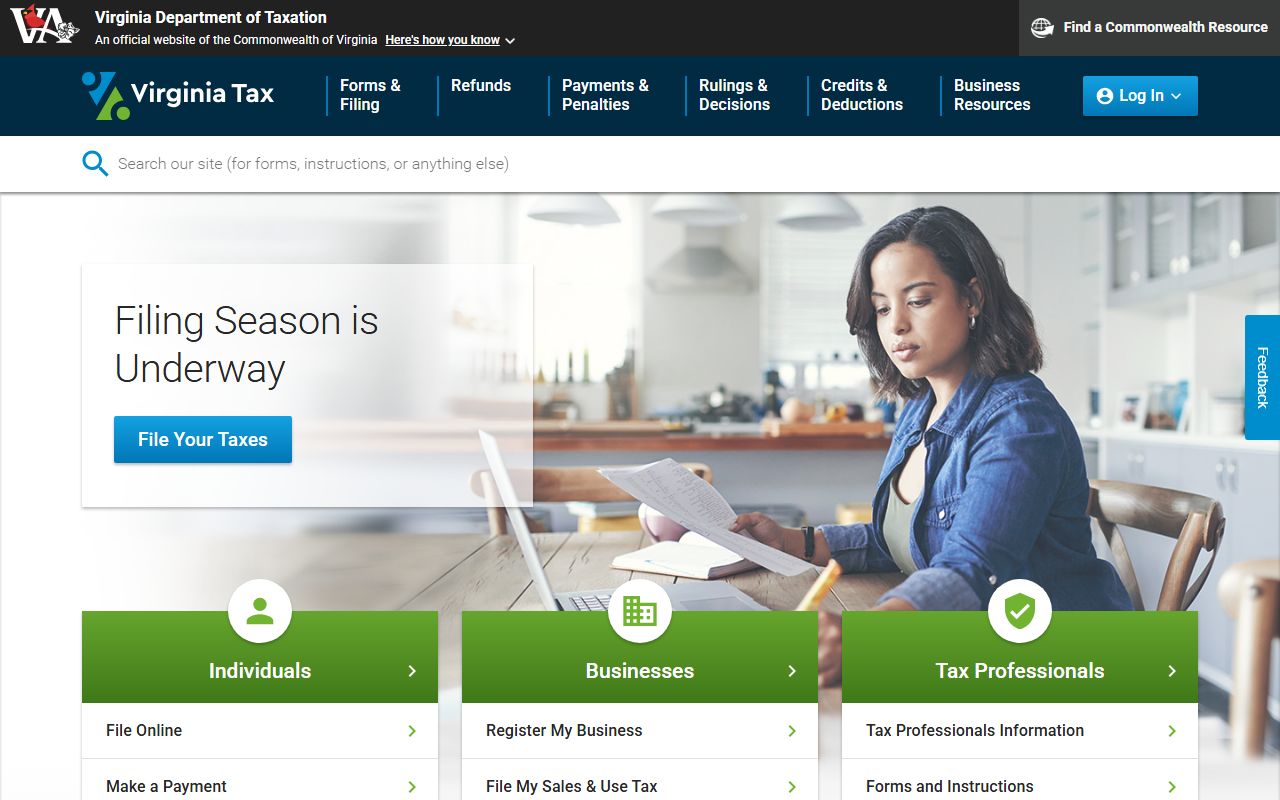
This page from tax.virginia.gov explains the legal framework that applies to all Virginia localities, including Buckingham County.
Tax Relief Programs
Buckingham County administers several tax relief programs for qualifying property owners. The most widely used is the elderly and disabled exemption under Virginia Code § 58.1-3210. This program reduces or eliminates real estate taxes for homeowners who meet age and income requirements set by the county. To qualify, you generally must own and live in the property as your primary residence, meet a minimum age requirement (often 65), and fall under an income cap. The Commissioner of the Revenue's office administers this program and can tell you the specific thresholds Buckingham County uses.
Veterans who have a 100 percent service-connected total and permanent disability rating from the U.S. Department of Veterans Affairs may qualify for a full exemption from real estate taxes under § 58.1-3219.5. This exemption also extends to the surviving spouse of a qualifying veteran, subject to conditions set by state law. To apply, contact the Commissioner of the Revenue's office and provide documentation of the disability rating and proof of ownership and residency.
Additional relief options may be available through the Virginia Department of Housing and Community Development at dhcd.virginia.gov. DHCD administers programs that can help low-income homeowners with property tax obligations. Eligibility for state programs varies, so check the DHCD website or call their office for current program details.
The following image from DHCD's website shows relief resources available to Virginia homeowners.

DHCD offers resources that complement local tax relief programs like those administered by Buckingham County.
Land Books and Records Access
Virginia counties are required by § 58.1-3301 to maintain land books that record every parcel of real property in the county, along with its owner, assessed value, and tax information. These land books are public records. In Buckingham County, the land book is maintained by the Commissioner of the Revenue and is open for inspection during normal office hours. Historical land books may also be available through the county or through the Library of Virginia, which archives older public records for many Virginia localities.
Land books are a useful research tool for more than just current tax information. They can show ownership history over time, track changes in assessed values from one reassessment to the next, and help identify when a parcel was subdivided or combined with adjacent land. Real estate attorneys, title examiners, and researchers often use land books alongside Circuit Court deed records to build a complete chain of title for a property.
Under § 58.1-3331, all assessment records and land books must remain open to public inspection. This means you can visit the Commissioner's office, request to see the land book, and review entries for any parcel without paying a fee for access, though copying fees may apply.
The image below shows the Virginia Code section that governs public inspection of assessment records.
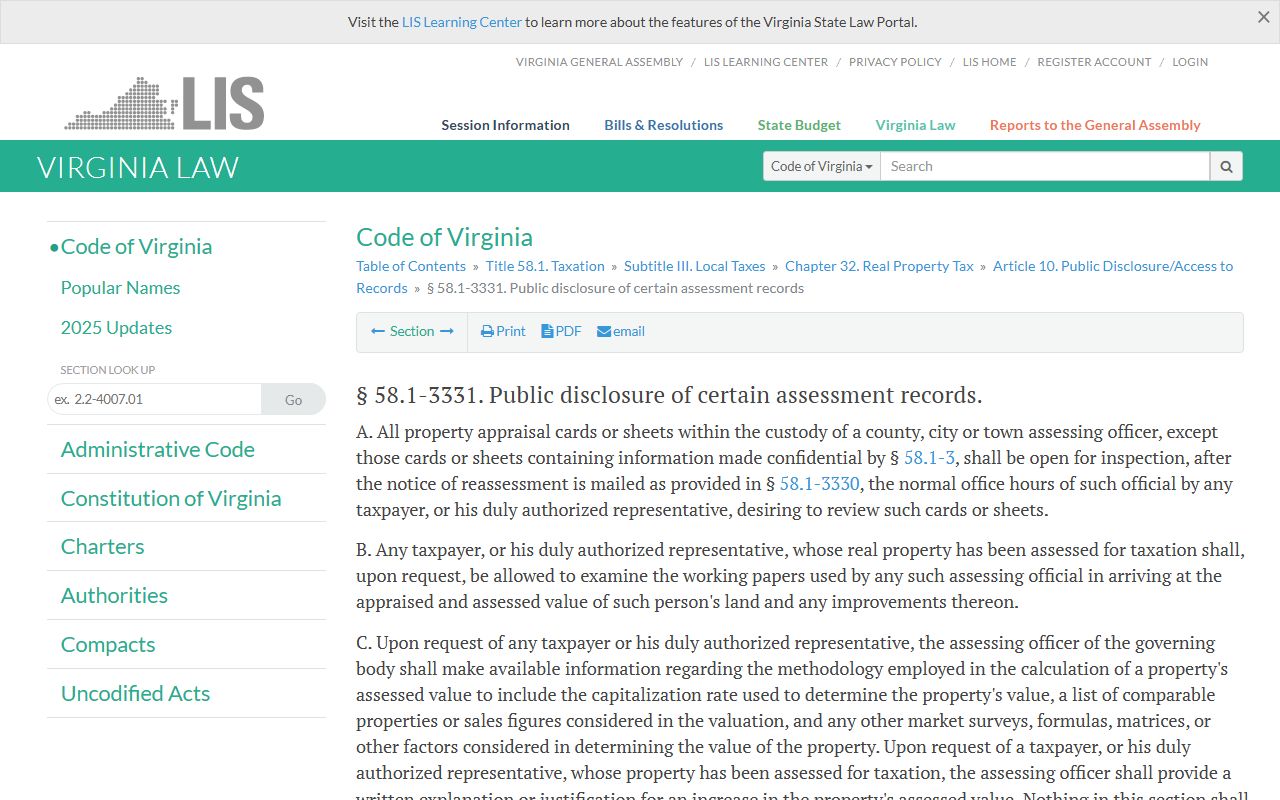
Section 58.1-3331 of the Virginia Code is the statute that keeps all county assessment records open to the public.
Cities in Buckingham County
Buckingham County has no independent cities within its boundaries. The county seat is Buckingham Court House, an unincorporated community that houses county government offices. Nearby independent cities in the region include Lynchburg, which is located to the west in Campbell County.
Nearby Counties
Buckingham County borders several counties in central Virginia. Property owners near county lines may find it helpful to check adjacent county records as well.