
Find Property Tax Records in Craig County
Craig County property tax records are maintained by the Commissioner of the Revenue and the Treasurer, both based in New Castle, the county seat. Located in western Virginia near the Alleghany Highlands, Craig County keeps these records as open public documents that anyone can access to find assessment values, ownership information, and tax payment status for parcels throughout the county. Each parcel file includes the owner name, parcel number, assessed land and improvement values, and a history of tax payments. Virginia law requires all Craig County property tax records to be open for public inspection, so buyers, researchers, and property owners can look up any parcel by visiting the county offices in New Castle.
Craig County Overview
Commissioner of the Revenue
The Craig County Commissioner of the Revenue assesses all real property in the county at fair market value as required by Virginia Code § 58.1-3200. This office maintains a parcel-level record for every piece of real estate in Craig County, covering the owner's name, parcel identification number, legal description, land and improvement values, and total assessed value. These records are used to generate the annual tax levy and are updated when property changes hands, when new construction occurs, or when the county conducts a reassessment.
Craig County is one of Virginia's smaller and more rural counties, with large amounts of forested land and agricultural property alongside scattered residential development. The Commissioner applies appropriate valuation methods for each property type. Timberland and farm parcels may qualify for use-value assessment under state programs, which values the land based on its productive use rather than its potential sale price. This can result in significantly lower assessed values for qualifying agricultural and forested land. Contact the Commissioner's office in New Castle to ask about eligibility for use-value assessment and the application process.
When property sells in Craig County, the deed is recorded at the Circuit Court clerk's office, and the Commissioner's records are updated to reflect the new owner. If you've recently purchased land or a home here, confirm that your ownership is reflected in the Commissioner's files to ensure tax bills come to the right address. Staff at the Commissioner's office can look up records and make corrections if needed. The office is open during standard weekday hours.
Under § 58.1-3330, property owners must receive written notice when a reassessment raises their assessed value above a set threshold. That notice includes instructions for requesting a review or filing a formal appeal with the Board of Equalization.
Craig County Treasurer
The Craig County Treasurer collects real estate taxes and personal property taxes based on values set by the Commissioner of the Revenue. The Treasurer's office processes payments in person at the New Castle courthouse, by mail, and through any online payment methods the county offers. Check the county's website at craigcountyva.gov for current tax due dates and payment options.
Tax records held by the Treasurer's office show whether any given parcel's taxes are current or delinquent. Delinquent real estate taxes are a lien on the property under Virginia law, and that lien stays with the land through a sale unless it is resolved. If you're buying property in Craig County, a title search will include a check with the Treasurer to confirm no outstanding tax balances exist on the parcel. The Treasurer can issue written confirmation of tax status upon request, and that document is typically required as part of the closing process.
For questions about why your bill is what it is, the Commissioner's office is the right first stop because they set the values. For payment confirmations, receipts, or questions about delinquent amounts, the Treasurer handles those directly. In a smaller county like Craig, both offices typically have staff who can answer basic questions and direct you appropriately if your question falls in the other office's domain.
The following image is from the Craig County official government website.
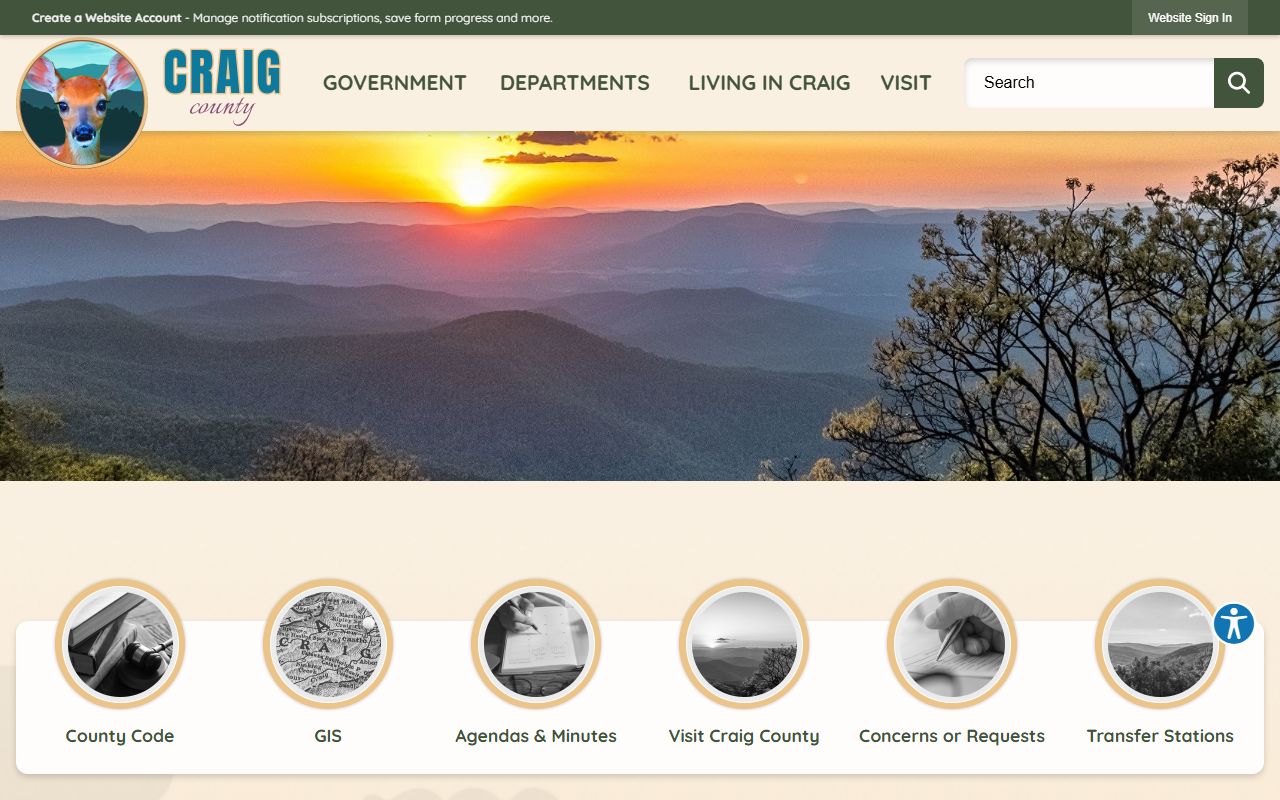
Both the Commissioner and Treasurer departments are accessible through the Craig County government website.
Searching Property Tax Records
Visit the Craig County website at craigcountyva.gov to see if any online property search tool is available. Some Virginia counties, even smaller ones, contract with assessment software vendors who provide a public-facing portal for looking up parcel data. If Craig County has such a tool, it will typically let you search by owner name, address, or parcel number to view basic assessment information.
If no online portal is available, the Commissioner of the Revenue's office in New Castle is the place to go. Under Virginia Code § 58.1-3331, all assessment records must be open for public inspection during normal business hours. Staff can look up records for any parcel, and you do not need to state a reason or have a legal interest in the property. Copies of records are available for a small fee. In rural counties, the Commissioner's office often has the most complete and accurate records for local parcels, particularly for older rural tracts with long histories.
The Circuit Court Clerk's office in New Castle holds deed records and plats for Craig County. These records complement the Commissioner's assessment files by showing ownership transfers and legal descriptions in more detail. Virginia FOIA also gives you the right to request records in writing if you need bulk data or records in a specific format.
Assessment in Craig County
Craig County must assess all real property at 100 percent of fair market value as required by § 58.1-3200. In a rural county with limited recent comparable sales, the Commissioner uses available market data along with cost and income approaches where applicable to estimate values for properties that don't transact often. For timberland, the Commissioner may use a combination of timber market data and land productivity factors to arrive at a fair value. The goal is the same regardless of property type: what would a willing buyer pay a willing seller in an open-market transaction.
General reassessments are required by state law at least every six years for counties Craig's size. Between reassessment cycles, the Commissioner's office updates parcels when changes occur. A recent sale, new home construction, or demolition will each trigger a review. In a county with low transaction volume, these individual updates are especially important for keeping the tax roll accurate between formal reassessments.
If you believe your value is too high, start with the Commissioner's office and ask to see the data behind your assessment. If informal resolution fails, you can appeal to the Board of Equalization under § 58.1-3378. The Board holds hearings under § 58.1-3379 where you can present evidence such as a recent appraisal or comparable sales data to support your case. The Board has authority to raise or lower values based on the evidence presented.
The following image is from the Virginia Department of Taxation, which sets the statewide framework for property assessment.

The Virginia Department of Taxation at tax.virginia.gov provides the legal and regulatory framework that Craig County's assessment process must follow.
Tax Relief Options
Craig County administers a real estate tax relief program for elderly and disabled homeowners under Virginia Code § 58.1-3210. Homeowners who own and occupy their home as a primary residence and who meet the county's income and age requirements can receive a reduction or full exemption. The Commissioner of the Revenue administers applications. Contact the office to get the current eligibility thresholds and the application form. Applying early helps ensure that relief is in place when tax bills are generated.
Veterans rated 100 percent totally and permanently disabled by the Department of Veterans Affairs are entitled to a full exemption from real estate taxes on their primary residence under § 58.1-3219.5. A surviving spouse of a qualifying veteran may also be eligible to continue the exemption under conditions set by state law. Bring your VA disability rating documentation and proof of residency and ownership to the Commissioner's office to begin the application.
Additional support for low-income homeowners is available through the Virginia Department of Housing and Community Development at dhcd.virginia.gov. DHCD programs can help qualifying residents manage housing-related costs, including property taxes, and may complement local relief programs for Craig County residents who need extra assistance.
Land Books and Records
Virginia law under § 58.1-3301 requires the Commissioner of the Revenue to maintain a land book for Craig County. This is a complete public record listing every parcel in the county, the owner's name, and the assessed value. It is open for inspection at the Commissioner's office without charge, though copying fees apply. Older editions of the land book may be available through the county or through the Library of Virginia's archives, which holds historical land books for many Virginia localities.
In a rural county like Craig, land book research is especially valuable for properties that have been in the same family for generations or that involve old survey descriptions without current plat maps. By reviewing land book entries over a series of years, researchers can often identify when ownership of a parcel changed and how values shifted through successive reassessments. This approach is commonly used in title examination to fill in gaps in the chain of title for rural land.
Under § 58.1-3331, all assessment records must be open to public inspection. Visit the Commissioner's office in New Castle to access these records in person. No special authorization or standing is required.
Cities in Craig County
Craig County has no independent cities within its boundaries. The county seat of New Castle is a small unincorporated community. Nearby cities with their own tax systems include Roanoke and Salem to the east.
Nearby Counties
Craig County borders several counties in western Virginia. Property located near these county lines may benefit from checking adjacent county records.