
Alleghany County Real Estate Tax Records
Alleghany County property tax records are handled by two elected offices: the Commissioner of the Revenue, who assesses real estate and personal property, and the Treasurer, who collects taxes and manages payments. Both offices are located in the county seat area and serve residents and property owners throughout the Alleghany Highlands region, including the communities of Clifton Forge, Iron Gate, Low Moor, and the surrounding rural areas. This page explains how to find, access, and use Alleghany County property tax records.
Alleghany County Overview
Commissioner of the Revenue
The Alleghany County Commissioner of the Revenue is responsible for assessing all real estate and personal property in the county at fair market value. Virginia Code § 58.1-3200 requires this 100% fair market value standard statewide. The Commissioner uses property characteristics, recent sales data, and market analysis to set values for the county's mix of residential homes, farms, timber land, and commercial properties.
Assessment records kept by this office include the parcel ID, owner of record, legal description, land value, improvement value, and total assessed value. When properties change hands, ownership information is updated based on deeds recorded in the Circuit Court. When improvements are added or structures are torn down, the Commissioner adjusts assessment records accordingly. You can contact the Commissioner's office at co.alleghany.va.us to get information about a specific parcel or ask about the assessment process for your property.
The following image shows the Alleghany County official government website, which is the starting point for finding Commissioner of the Revenue and Treasurer contact information.
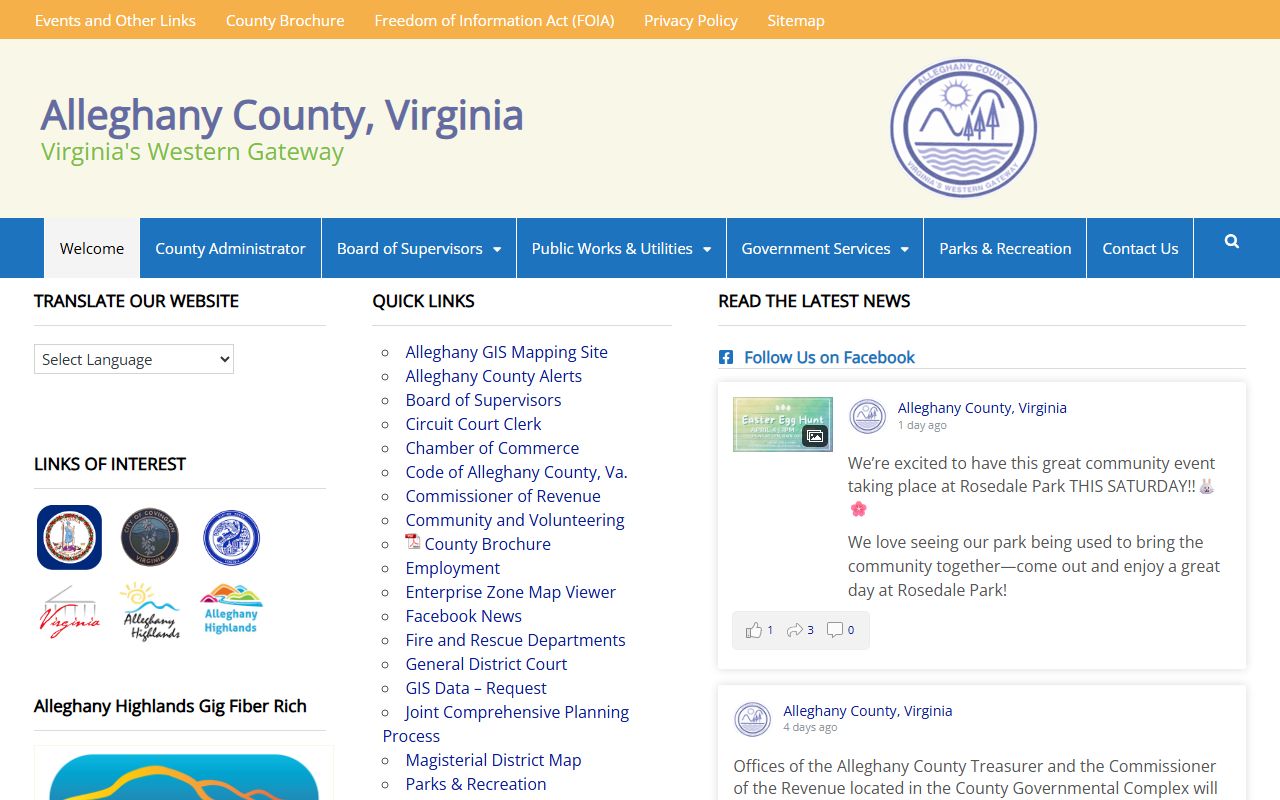
The Alleghany County website provides direct access to both the Commissioner of the Revenue and Treasurer departments for property tax questions and record requests.
The Commissioner's office also administers tax relief programs for qualifying residents. Under § 58.1-3210, elderly and disabled property owners may qualify for a reduction in real estate taxes. And under § 58.1-3219.5, disabled veterans with total and permanent service-connected disabilities may qualify for a full exemption on their primary residence. The Commissioner's office can provide current eligibility criteria and application materials for both programs.
Alleghany County Treasurer
The Alleghany County Treasurer collects real estate taxes, personal property taxes, and other locally assessed charges. Tax bills go out based on assessments from the Commissioner's office. The Treasurer's office accepts payments in person, by mail, and online where available. Late payments are subject to interest and penalties, so it's important to know when bills are due.
Records at the Treasurer's office show the tax status of any parcel in the county, including whether taxes are current or delinquent. Delinquent taxes create a lien on the property. If taxes go unpaid long enough, the county may initiate a tax sale process to recover the owed amounts. Anyone researching a property before purchase should confirm tax status with the Treasurer's office as part of due diligence.
The image below shows the Alleghany County Treasurer's webpage, which provides payment options and contact details for tax-related questions.
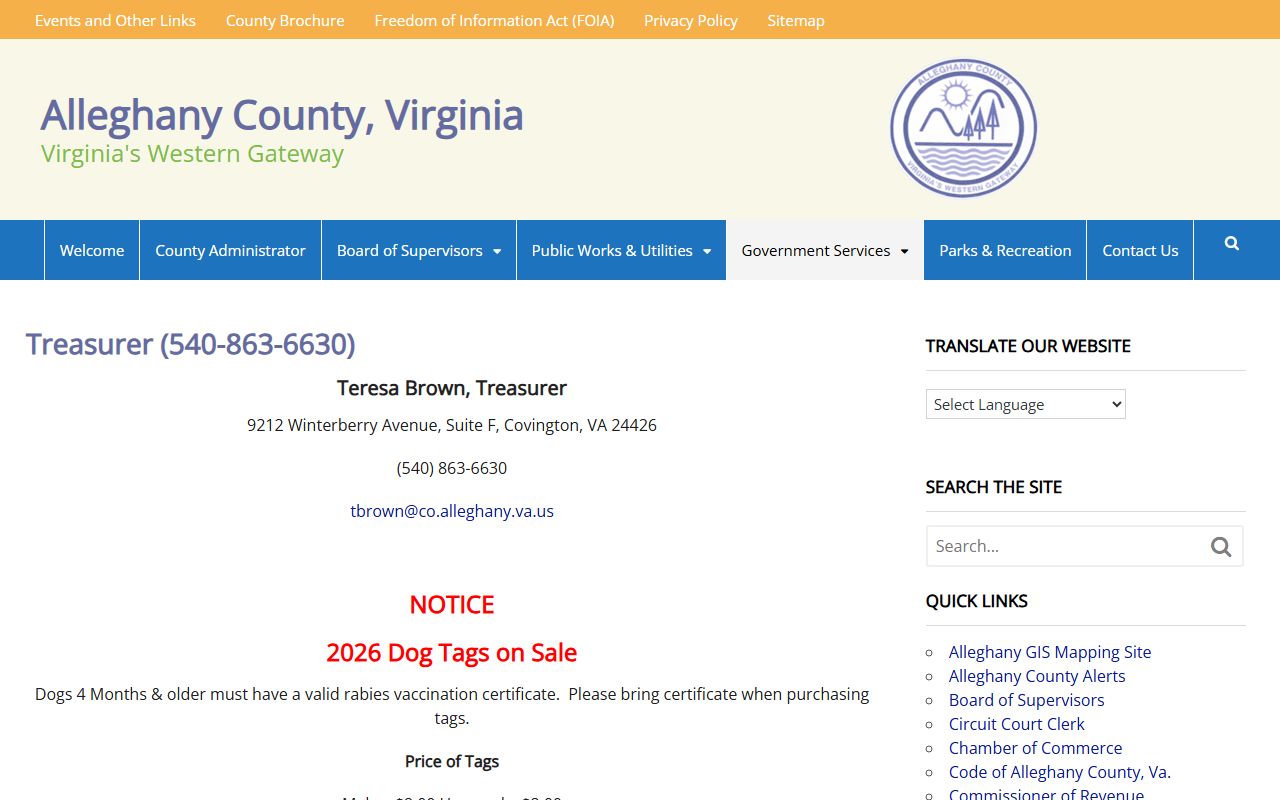
The Treasurer's Office page on the Alleghany County website explains how to pay taxes, what payment methods are accepted, and how to reach staff with billing questions.
How to Search Property Tax Records
To search Alleghany County property tax records, start at the county's official website at co.alleghany.va.us. The site links to both the Commissioner's and Treasurer's offices. Check each department page for any available online property search tools. Some Virginia counties provide searchable databases of assessment records through their websites, while others rely on in-person or telephone inquiries.
Under Virginia Code § 58.1-3331, assessment records are open for public inspection. This means you have the right to view records at the Commissioner's office without providing a reason. Staff can pull up data by parcel number, owner name, or address. If you need a copy of records, a small per-page fee may apply. For large data requests, a written FOIA request directed to the county administrator may be more efficient.
The Virginia Department of Taxation website provides statewide context for how local assessment offices operate and what types of records they maintain. That background can help you know what to ask for when you contact the Alleghany County offices directly.
Assessment Process and Appeals
Alleghany County assessors use mass appraisal methods to value real property across the county. The process analyzes sales data for comparable properties and applies those market-based values to similar parcels. Rural and forested properties, which make up a significant portion of Alleghany County's land area, are valued differently than residential subdivisions. Timber and agricultural land may be assessed using use-value assessments under separate programs that can lower the tax burden for qualifying landowners.
Under § 58.1-3332, property owners can inspect their own appraisal card to see exactly what data the assessor has on file. If the card contains errors, such as the wrong square footage, an extra bedroom that doesn't exist, or a building condition rating that doesn't match the actual state of the structure, you can bring those errors to the Commissioner's attention. Correcting data errors can lead to a lower assessment without the need for a formal appeal.
When data corrections aren't enough, property owners can appeal to the Board of Equalization. Under § 58.1-3378, the board is appointed by the Circuit Court and operates independently of the Commissioner. Property owners present evidence that their assessment exceeds fair market value, and the board can adjust the value based on that evidence. Hearing procedures under § 58.1-3379 govern how appeals are scheduled and conducted. After the board rules, owners who remain unsatisfied may appeal further to the Circuit Court.
The full text of Virginia Code Title 58.1, Chapter 32 covers the assessment framework that applies to Alleghany County and all other Virginia localities.
Tax Relief Programs
Alleghany County administers real estate tax relief for elderly and disabled residents under § 58.1-3210. To qualify, you must own and live in the property as your primary residence, meet age or disability requirements, and fall within income and asset limits the county sets each year. Eligible residents receive a reduction or full exemption from real estate taxes on their home. Contact the Commissioner of the Revenue's office for current income and net worth thresholds and to pick up an application.
Disabled veterans with total and permanent service-connected disabilities qualify for a full exemption from real estate taxes on their primary residence under § 58.1-3219.5. Surviving spouses of veterans killed in the line of duty are also eligible. Documentation from the U.S. Department of Veterans Affairs confirming the disability rating is required. The Commissioner's office processes these applications and can explain what paperwork is needed.
The Virginia Department of Housing and Community Development administers state-level programs that may provide additional financial assistance for Alleghany County homeowners facing housing cost burdens. These programs can complement local tax relief options for qualifying residents.
The image below shows the Virginia DHCD website, which lists programs that can help property owners in Alleghany County with housing costs, including resources that interact with local tax relief programs.
State housing programs through DHCD can provide support for Alleghany County residents who qualify based on income, age, disability, or veteran status.
Land Books and Public Records
Virginia Code § 58.1-3301 requires each county Commissioner of the Revenue to maintain a land book listing all taxable real property, the owner, and the assessed value. Alleghany County's land book is a public record open for inspection at the Commissioner's office. It provides a reliable snapshot of property ownership and valuations at a given point in time, useful for title research, property due diligence, and historical inquiry.
Older land books for Alleghany County may be available at the county courthouse or through the Library of Virginia, which preserves historical records from across the state. For current records, the Commissioner's office is the primary source. For deed records and plats, the Alleghany County Circuit Court clerk's office maintains recorded land instruments and can assist with property research.
Property tax records are part of Virginia's broader public records system. Anyone can request access to these records under the Freedom of Information Act. The county must respond to FOIA requests within five business days, though extensions apply in some cases. Most routine property record requests can be handled informally by visiting or calling the Commissioner's office.
Cities in Alleghany County
Covington is an independent city adjacent to Alleghany County and is not part of the county for tax purposes. The city has its own assessment and tax collection system. Visit the Covington city page for property tax records specific to that independent city. Other communities in the Alleghany Highlands area, including Clifton Forge and Iron Gate, are towns within Alleghany County rather than independent cities.
Nearby Counties
Alleghany County borders several counties in western Virginia. Links below lead to property tax record pages for neighboring counties.