
Augusta County Real Estate Tax Records
Augusta County property tax records are maintained by the Commissioner of the Revenue and the Treasurer, serving this large Shenandoah Valley county from the county seat at Verona. Augusta County surrounds but does not include the independent cities of Staunton and Waynesboro, each of which has its own separate assessment and tax system. This page covers property tax records specifically for Augusta County, including how to search assessments, pay taxes, and apply for relief programs available to qualifying residents.
Augusta County Overview
Commissioner of the Revenue
The Augusta County Commissioner of the Revenue assesses all real estate and personal property in the county at fair market value. Virginia law under § 58.1-3200 mandates 100% fair market value assessment, and the Commissioner's office uses mass appraisal methods along with field inspections to meet this standard. Augusta County's land includes Shenandoah Valley farmland, mountain properties, rural residential tracts, and commercial areas along major corridors like Interstate 81.
Assessment records kept by the Commissioner include the owner's name and contact address, the parcel identification number, the legal description, and both the land value and improvement value that make up the total assessed value. Property characteristics like building size, year built, and condition are also documented in the assessment files. These records are updated when deeds are recorded in the Circuit Court and when construction projects are completed or structures are removed.
The Commissioner's office also administers land use programs that allow agricultural and forested land to be assessed at use value rather than market value. This program can substantially reduce real estate taxes for qualifying farms and timber tracts. Applications must be filed with the Commissioner's office, and the land must meet specific use criteria to qualify. Contact the office at co.augusta.va.us for information on current program requirements.
Under § 58.1-3330, the county must notify property owners when their assessed value changes. If you receive a notice, the Commissioner's office can explain what drove the change and provide the data behind the new assessment.
Augusta County Treasurer
The Augusta County Treasurer collects real estate taxes, personal property taxes, and other locally assessed charges. Real estate tax bills are issued based on assessments from the Commissioner's office. The Treasurer's office processes payments in person, by mail, and online. Tax due dates are set by the board of supervisors and generally fall in the spring and fall of each year.
If taxes on a property are overdue, they accrue interest and may be subject to additional penalties. Delinquent real estate taxes are a lien on the property, and this lien carries forward through ownership changes unless cleared. If you are buying property in Augusta County, confirming the tax status with the Treasurer's office before closing is an important step. The Treasurer can provide a certificate of tax status for use in real estate transactions.
The Treasurer's office can also tell you about payment options, including whether partial payment plans might be available for accounts with large balances. Augusta County property owners facing hardship should contact the Treasurer's office directly to discuss their situation.
How to Search Augusta County Property Records
Start at the Augusta County official website at co.augusta.va.us. Navigate to the Commissioner of the Revenue and Treasurer department pages to find any available online search tools. When an online property database is offered, you can search by owner name, parcel ID, or address to view assessment data and tax information without visiting an office.
For in-person record access, the Commissioner's office in Verona is the primary destination. Under Virginia Code § 58.1-3331, assessment records are open for public inspection without requiring a stated purpose. Staff can pull up records and print copies. The appraisal card for each property, which shows the characteristics used to calculate the assessed value, can be requested under § 58.1-3332.
The Augusta County Circuit Court clerk's office holds deeds, plats, and other recorded instruments for the county. These records complement assessment data and help establish the full ownership and legal history of any parcel. The clerk's office is also located in the county government complex and can be reached through the county's main website. The Virginia Department of Taxation provides background on how Virginia's local assessment system works for those who want that broader context.
The image below shows the Virginia Department of Taxation's website, which governs and supports the local assessment process followed by Augusta County's Commissioner of the Revenue.

The Virginia Department of Taxation sets assessment standards and provides oversight that ensures Augusta County's records meet statewide requirements for accuracy and public access.
Assessment Process and Appeals
Augusta County assessors apply mass appraisal methods to set values for the county's diverse mix of properties. Residential homes are typically valued by comparing them to recent sales of similar homes in the county or comparable nearby markets. Agricultural land may use the use-value program, while commercial properties often require income-based or sales comparison approaches depending on the property type. The Commissioner's office uses these tools to produce consistent, market-based values across the county's large geographic area.
Property owners can check the data behind their assessment by reviewing their appraisal card under § 58.1-3332. This card shows lot size, building measurements, construction type, year built, condition rating, and other factors that went into the calculation. Errors in the card, such as a building size that doesn't match actual measurements or improvements listed that were never built, can lead to inflated values. Documenting and reporting such errors to the Commissioner is the first step in seeking a correction.
Formal appeals in Augusta County go to the Board of Equalization, established under § 58.1-3378 and operating independently of the Commissioner. Property owners who believe their value exceeds fair market value can present evidence at a hearing. The board follows procedures under § 58.1-3379 and can lower, raise, or confirm the assessed value. Further appeal to the Circuit Court is available after the board issues its ruling.
Tax Relief Programs
Augusta County provides real estate tax relief for elderly and disabled residents under Virginia Code § 58.1-3210. To qualify, residents must own and occupy their home, meet age or disability requirements, and stay within income and net worth limits the county has established. Qualifying residents may receive a full exemption or a partial reduction in their real estate tax bill. The Commissioner's office handles applications and can provide the current income and asset limits, which the board of supervisors may adjust annually.
Augusta County veterans with total and permanent service-connected disabilities are eligible for a full exemption from real estate taxes under § 58.1-3219.5. Surviving spouses of veterans killed in action also qualify. Documentation from the U.S. Department of Veterans Affairs certifying the disability rating is required. The Commissioner's office processes applications and can explain what to include.
The Virginia Department of Housing and Community Development provides statewide housing assistance and other programs that may help Augusta County residents who are struggling with housing costs. These programs can complement local relief options to reduce the overall cost burden for eligible households.
The image below shows the Virginia Code notice requirement that ensures Augusta County property owners are informed when their assessments change.
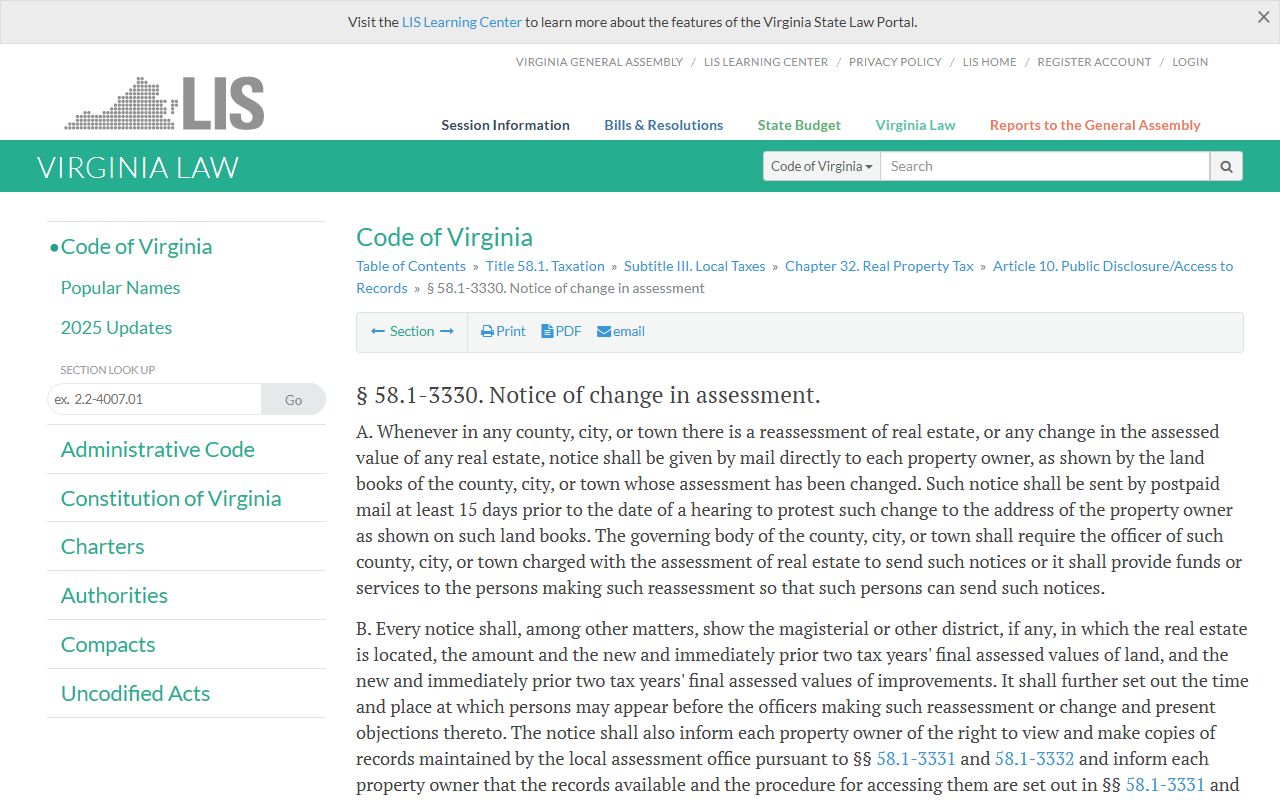
The notice requirement under § 58.1-3330 gives Augusta County property owners an early warning when their assessed value changes, allowing time to review the new value before the tax bill arrives.
Land Books and Record Access
Under Virginia Code § 58.1-3301, the Augusta County Commissioner of the Revenue maintains a land book listing all taxable real property in the county, the owner of record, and the assessed value. This document is a public record and can be inspected at the Commissioner's office during business hours. The land book is particularly useful for researchers and title examiners who need a complete list of county property holdings at a given point in time.
For historical land books, the Augusta County courthouse and the Library of Virginia may hold older editions. The Library of Virginia maintains historical records from localities across the state and is a good resource for tracing historical ownership back many years. For current data, the Commissioner's office is the definitive source.
Deed records in the Augusta County Circuit Court clerk's office provide the legal documentation behind property ownership. Combining deed research with the Commissioner's assessment records and the land book gives a comprehensive picture of any parcel's history, description, and current tax standing. All these records are open to the public under Virginia's Freedom of Information Act and the specific public inspection right in § 58.1-3331.
Cities Near Augusta County
Two independent cities border Augusta County and have their own separate property tax systems.
Nearby Counties
Augusta County is surrounded by several counties in the Shenandoah Valley and western Virginia. Use the links below to find property tax records for neighboring areas.