
Bath County Property Tax Records
Bath County property tax records are maintained by the Commissioner of the Revenue and the Treasurer, both located at the county seat in Warm Springs. This rural western Virginia county has a predominantly agricultural and forested landscape, and its property tax records cover a range of parcel types from small residential lots to large rural tracts. This page explains how to search Bath County property tax records, what data is available, and what tax relief options may apply to qualifying residents.
Bath County Overview
Commissioner of the Revenue
The Bath County Commissioner of the Revenue assesses all real property in the county at fair market value as required by Virginia Code § 58.1-3200. Bath County's land is overwhelmingly rural, consisting largely of mountain properties, timber tracts, agricultural land, and residential properties clustered in small communities around Warm Springs, Hot Springs, and Millboro Springs. Valuing this mix of properties requires an understanding of rural land markets, which differs considerably from the suburban and urban appraisal approaches used in more densely developed counties.
The Commissioner's records for each parcel include the owner's name and mailing address, the parcel ID number, the property's legal description, land and improvement values, and the full assessed value. Ownership records are updated when deeds are recorded at the Circuit Court. Improvements are updated after construction inspections. If you have questions about your property's current assessment or the data the county has on file, contact the Commissioner's office at bathcountyva.org.
Bath County may offer a land use program that allows agricultural and forested parcels to be assessed at use value rather than market value. This can result in significantly lower property taxes for qualifying landowners. Contact the Commissioner's office to ask whether your land qualifies and how to apply. Use-value applications typically require documentation of how the land is being used and are reviewed on an annual cycle.
Under § 58.1-3330, the county must notify you in writing when your assessed value changes. The Commissioner's office is the right first contact if you receive such a notice and have questions about what changed.
Bath County Treasurer
The Bath County Treasurer collects real estate taxes and personal property taxes based on assessments from the Commissioner's office. Tax bills are sent according to the county's billing schedule, with due dates set by the board of supervisors. Payment can be made in person, by mail, or through online options if available. Late payments accrue interest and may be subject to penalties, so knowing the due dates for Bath County taxes is important for property owners.
The Treasurer's records show tax payment history and current balance for each parcel. If you are researching a property before buying it in Bath County, the Treasurer can tell you whether taxes are current or whether any delinquent amounts are outstanding. Unpaid taxes create a lien on the property that must be cleared before a clean title can be transferred. The Treasurer's office can also confirm what amounts need to be paid to bring an account current.
Bath County is a small, rural locality, and the Treasurer's office staff can often answer questions quickly and informally. If you're not sure where to start with a property tax question, calling the Treasurer's office is a reasonable first step, and they can direct you to the Commissioner if the question is about the assessment amount rather than the tax bill.
How to Search Property Tax Records
To find Bath County property tax records, visit bathcountyva.org and look for links to the Commissioner of the Revenue and Treasurer departments. Check those pages for any online property search tool. Small rural counties like Bath may rely more on in-person or telephone inquiries than online databases, but the county website is the best starting point to find out what's available.
Under Virginia Code § 58.1-3331, assessment records are open for public inspection. You can visit the Commissioner's office during business hours and ask to view records for any parcel. Staff can search by owner name, parcel number, or address. Copies of records are generally available for a small fee. For larger requests or bulk data, a written FOIA request is an option, with the county required to respond within five business days.
For deed and land record research, the Bath County Circuit Court clerk's office holds recorded instruments for the county. The clerk's office is in Warm Springs and can be reached through the county's main government website. Combining deed records with the Commissioner's assessment files gives a complete picture of any parcel's ownership and tax history.
The image below shows the Virginia Department of Taxation website, which provides statewide context for how local assessment offices like Bath County's operate and what public record rights apply.
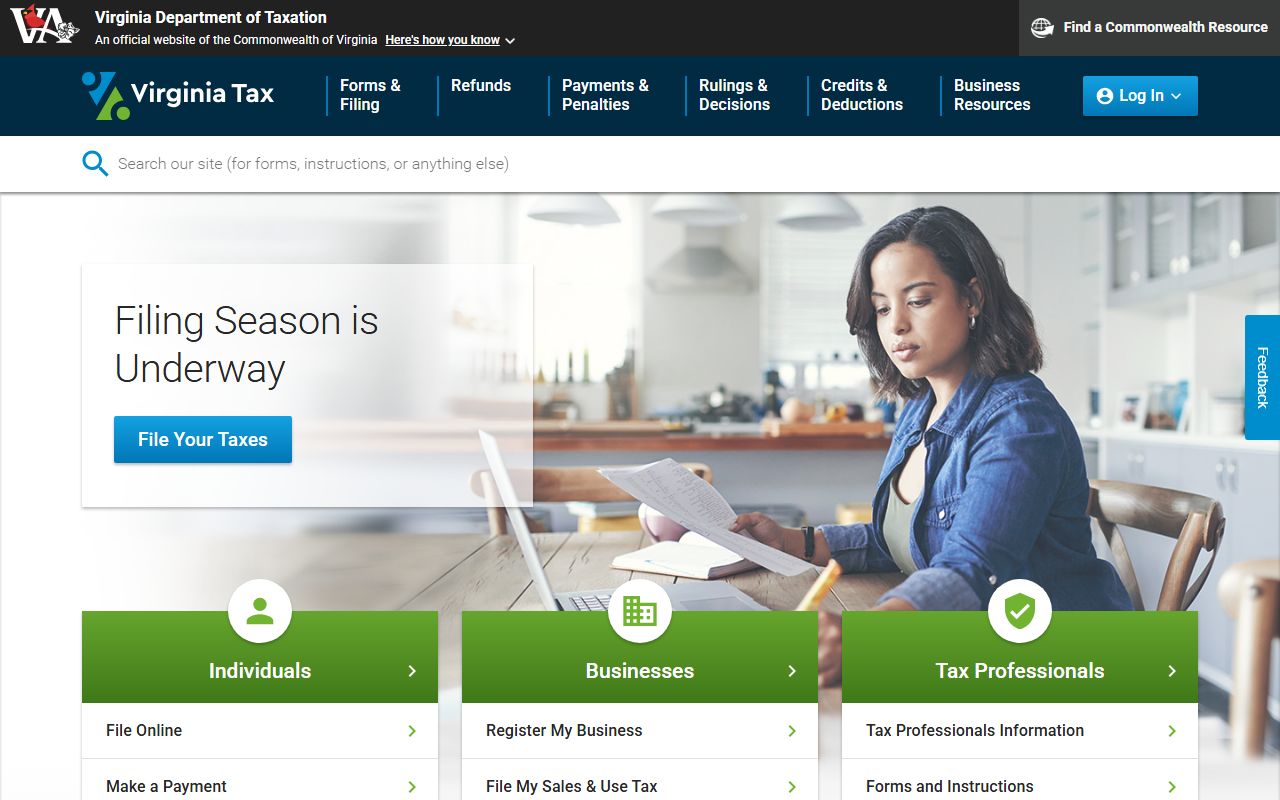
Virginia's Department of Taxation sets and enforces the standards that Bath County and all other Virginia localities must follow in assessing and recording property tax data.
Assessment Process and Appeals
Bath County real estate is assessed using mass appraisal methods adapted to its rural character. The Commissioner's office analyzes sales of comparable properties to set values for residential parcels. Agricultural and forested land, which makes up the bulk of Bath County's area, may be assessed under use-value programs that look at the productive value of the land rather than the price it might fetch on the open market. This distinction matters a great deal for landowners who farm or manage timber on their property.
To check the data behind your assessment, request your appraisal card under § 58.1-3332. The card shows what the Commissioner has on record for your property, including lot size, building dimensions, construction type, condition, and other factors used in setting the value. If any of this information is wrong, bringing the error to the Commissioner's attention with supporting documentation can result in a corrected assessment without requiring a formal hearing.
Formal appeals go to the Board of Equalization, which under § 58.1-3378 is appointed by the Circuit Court and operates independently of the Commissioner's office. Owners who believe their assessment exceeds fair market value present evidence at a hearing, and the board can adjust the value or leave it unchanged. Procedures follow § 58.1-3379. Circuit Court appeal is available after the board's decision.
Tax Relief Programs
Bath County offers real estate tax relief for elderly and disabled residents under Virginia Code § 58.1-3210. Residents who own and live in their home as a primary residence and meet age or disability requirements may qualify for a reduction or exemption from real estate taxes. Income and net worth limits apply and are set by the county board of supervisors. Contact the Commissioner of the Revenue's office for the current limits and application materials.
Veterans with total and permanent service-connected disabilities qualify for a full exemption from real estate taxes on their primary residence under § 58.1-3219.5. Surviving spouses of veterans killed in action or who died from a service-connected disability are also eligible. The Commissioner's office processes these applications and can tell you what documentation from the U.S. Department of Veterans Affairs is required.
The Virginia Department of Housing and Community Development offers housing assistance programs at the state level that may be useful for Bath County residents facing financial hardship. These programs can supplement local tax relief options and are worth checking if you are struggling to cover property tax costs alongside other housing expenses.
The image below shows the Virginia DHCD website, where Bath County residents can find information on state-level housing and financial assistance programs that may reduce their overall housing cost burden.

DHCD programs available statewide can help Bath County property owners who meet eligibility requirements based on income, age, disability, or veteran status.
Land Books and Record Access
Virginia Code § 58.1-3301 requires the Commissioner of the Revenue to maintain a land book listing all taxable real property, its owner, and its assessed value. Bath County's land book is a public document available for inspection at the Commissioner's office. For a small rural county like Bath, the land book provides a manageable record of property ownership that can be useful for a variety of legal and research purposes.
Historical land books may be available at the courthouse or through the Library of Virginia, which holds historical records from localities across the state. The Bath County Circuit Court clerk's office holds deeds, plats, and other land instruments and is a key resource for title research. These deed records, combined with the Commissioner's assessment files, give a complete picture of any parcel's history. All of these records are public under § 58.1-3331 and Virginia's Freedom of Information Act.
Cities in Bath County
Bath County contains no independent cities. The county seat, Warm Springs, is an unincorporated community. Hot Springs and Millboro Springs are also unincorporated communities within the county.
Nearby Counties
Bath County borders several counties in western Virginia. Select a neighboring county for property tax record information in that area.