
Find Property Tax Records in Caroline County
Caroline County property tax records are maintained by the Commissioner of the Revenue and the Treasurer in Bowling Green, the county seat. Situated between Fredericksburg and Richmond in eastern Virginia, Caroline County keeps these records as open public documents that any person may access to find current assessment values, ownership history, and tax payment status for any parcel in the county. Records include owner names, parcel identification numbers, assessed land and improvement values, and tax payment history for all taxable real property in Caroline County. You can search these records in person at the county offices in Bowling Green or through any online access the county provides.
Caroline County Overview
Commissioner of the Revenue
The Caroline County Commissioner of the Revenue is the office that assesses all real estate in the county. Virginia law under § 58.1-3200 requires assessment at 100 percent of fair market value. The Commissioner maintains records covering each parcel's owner, legal description, land and improvement values, parcel identification number, and assessment history. These records are what the Treasurer uses to generate real estate tax bills each year.
Caroline County's location between two major metro areas means its real estate market can shift fairly quickly, particularly for rural and agricultural land. The Commissioner uses comparable sales data from the local market to set values. When properties sell, those transactions inform the assessment process for surrounding parcels. The Commissioner's office also handles personal property assessments for vehicles and business equipment, which are separate from real estate records.
If you've recently purchased property in Caroline County, expect the Commissioner's files to be updated after the deed is recorded at the Circuit Court. From that point forward, tax bills should come in your name. If there's a delay or if a bill goes to the wrong party, the Commissioner's office can correct the ownership record. Call or visit the office in Bowling Green during regular business hours.
When the county runs a general reassessment, § 58.1-3330 requires that property owners receive notice if their value increases significantly. That notice comes from the Commissioner's office and includes information about the appeal process. Acting quickly after receiving such a notice is important, since appeal deadlines are set by state law.
Caroline County Treasurer
The Caroline County Treasurer handles collection of all locally assessed taxes. Real estate taxes and personal property taxes are the two largest components. The Treasurer's office generates bills based on values set by the Commissioner and processes payments made in person, by mail, or through any online payment option the county offers. Check the county website at co.caroline.va.us for current due dates and payment methods.
The Treasurer's records show the payment history for every parcel in the county. This is important for buyers, sellers, lenders, and title professionals who need to confirm that no outstanding tax liabilities exist on a property. Delinquent real estate taxes are a lien on the land under Virginia law, and that lien survives a sale unless it is resolved. A title company completing a real estate closing will check with the Treasurer to confirm current tax status before allowing a deed to record.
If you need confirmation that taxes are paid on a parcel you own, the Treasurer's office can provide a receipt or a current balance statement. For questions about why your bill changed from one year to the next, the Commissioner of the Revenue is the right office since the Treasurer can only adjust bills based on authorized assessment changes.
Virginia's Department of Taxation at tax.virginia.gov publishes resources explaining property tax collection procedures across the state.
How to Search Caroline County Property Records
Visit the Caroline County website at co.caroline.va.us to look for links to any online property search portal or GIS mapping system. Some Virginia counties provide public access to assessment data through web-based tools where you can search by owner name, parcel number, or street address. If such a tool is available, you can view assessed values, property details, and in some cases recent sales history without visiting the courthouse.
If no online tool is available, contact the Commissioner of the Revenue's office directly. Under Virginia Code § 58.1-3331, all assessment records are open for public inspection during normal business hours. Staff can pull up records for any parcel in the county. You do not need to explain why you want the information or have any legal interest in the property. Copies of records are available for a small fee.
Circuit Court deed records in Bowling Green complement the Commissioner's assessment files. Together these two sets of records can give you a fairly complete picture of a property's ownership and value history. The Circuit Court Clerk's office can be reached through the county's website and is open during standard business hours.
The following image shows the Virginia Code section that requires public access to all assessment records.
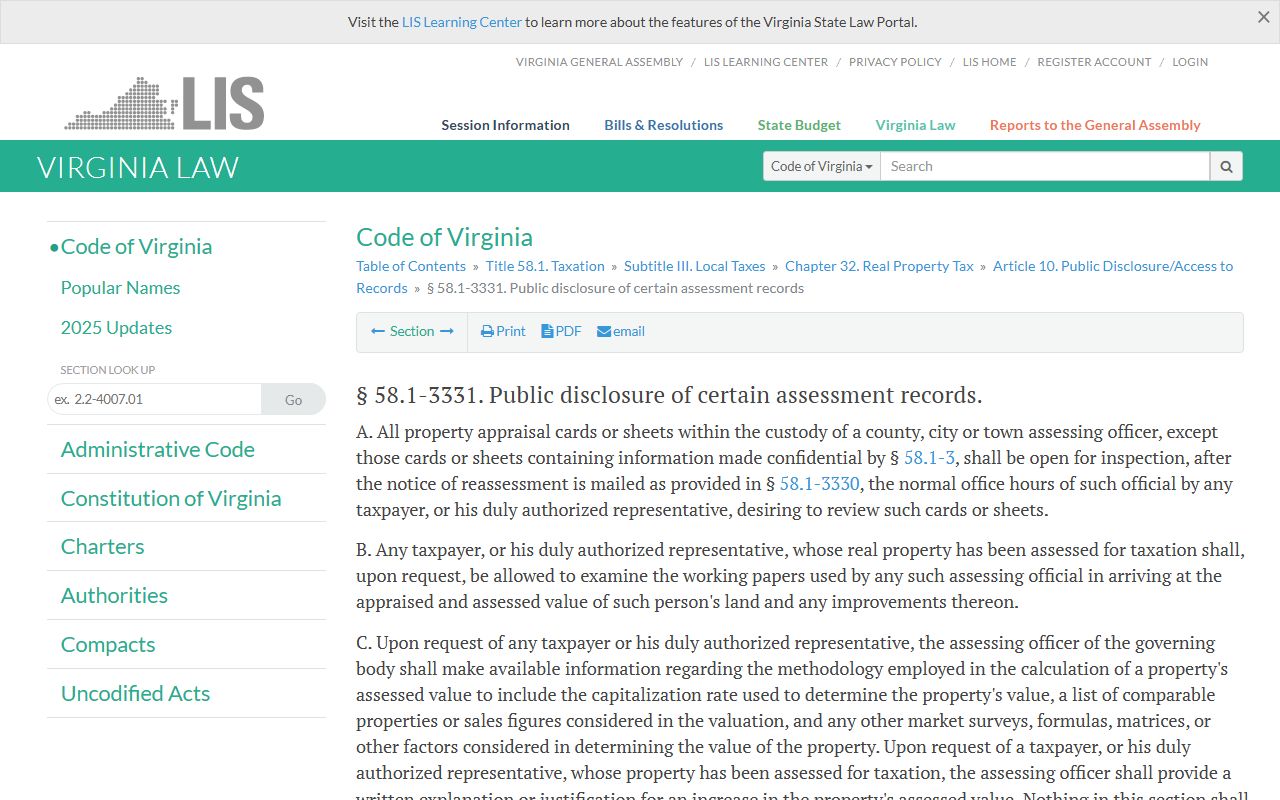
Section 58.1-3331 of the Virginia Code ensures that Caroline County, like all Virginia localities, must keep assessment records open to the public.
Assessment Process in Caroline County
Caroline County must assess all real property at 100 percent of fair market value as required by § 58.1-3200. The Commissioner of the Revenue uses data from open-market property sales, physical property inspections, and information about land use and improvements to arrive at values. The process aims to ensure that similar properties in similar condition are assessed similarly, distributing the local tax burden fairly.
State law requires counties to conduct general reassessments on a regular schedule. Between reassessments, individual parcels are updated as changes occur, such as new construction, demolition, or a property sale at a price well above or below the assessed value. The goal is to keep the tax rolls accurate even in years when no formal reassessment is underway. Caroline County's location in a corridor of growing real estate activity means values can move, and the Commissioner's office works to reflect those changes in a timely way.
Property owners have the right to appeal assessments they believe are too high. Start with the Commissioner's office. If the informal review does not result in a correction, you can file a formal appeal with the Board of Equalization under § 58.1-3378. Under § 58.1-3379, the Board must give you a hearing where you can present evidence. A recent appraisal from a licensed appraiser is often the strongest evidence you can bring.
The image below is from the state's real property assessment statutes page.
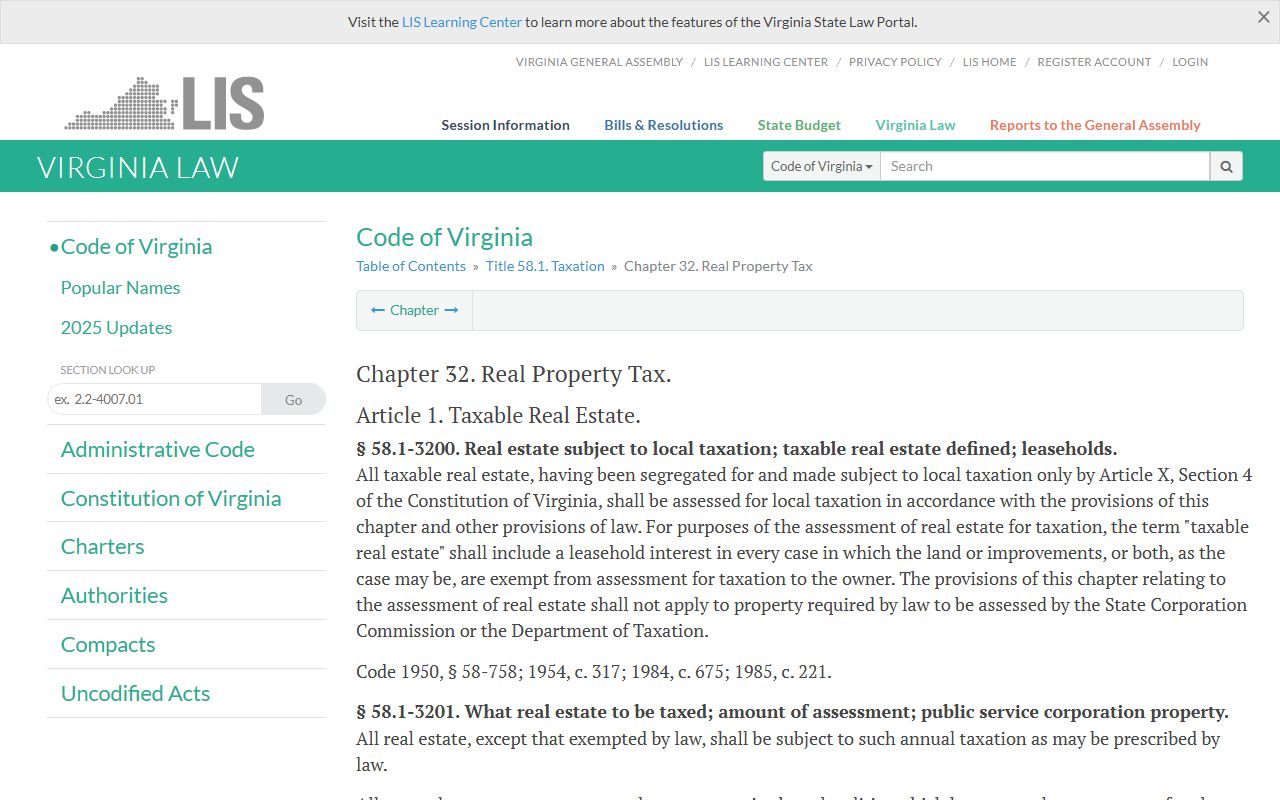
These statutes at law.lis.virginia.gov set out the full legal framework for how Caroline County conducts property assessments.
Tax Relief Options
Caroline County administers a real estate tax relief program for elderly and disabled homeowners under Virginia Code § 58.1-3210. To qualify, applicants must own and occupy their home as their primary residence and meet income and age requirements set by the county. If you qualify, the program can reduce or eliminate your annual real estate tax bill. Applications are processed through the Commissioner of the Revenue's office. Call or visit to get the current eligibility thresholds and to pick up an application.
Veterans who have been rated as 100 percent totally and permanently disabled by the Department of Veterans Affairs are entitled to a full real estate tax exemption under § 58.1-3219.5. The surviving spouse of a veteran who qualified under this exemption may also be eligible to continue receiving the benefit. Documentation of the disability rating and proof of ownership and residency are required to apply. The Commissioner of the Revenue's office handles these applications.
For residents who need additional support, the Virginia Department of Housing and Community Development at dhcd.virginia.gov offers housing assistance programs that may help with property tax costs. These state programs are separate from the local relief program but can be used alongside it by qualifying households.
Land Books and Records
The Commissioner of the Revenue maintains Caroline County's land book as required by Virginia Code § 58.1-3301. The land book is a complete listing of all real property in the county, showing each parcel's owner and assessed value for the current tax year. It is a public record that anyone can review. The land book has historically been one of the core documents of local government in Virginia, and it predates many of the county's other records systems.
Land books serve as a useful research tool for title attorneys, historians, and anyone tracing the ownership of a specific piece of land over time. By comparing land book entries from different years, you can see how a property's assessed value changed through successive reassessment cycles and identify when ownership transferred. When combined with Circuit Court deed records, land books provide a fairly complete ownership and value history for most parcels.
Under § 58.1-3331, the land book and all other assessment records must remain open for public inspection. This means you can visit the Commissioner's office in Bowling Green during regular business hours and ask to review the land book for any parcel in the county. There is no requirement that you have a particular reason for wanting the information.
Cities in Caroline County
Caroline County has no incorporated cities within its boundaries. The county seat of Bowling Green is an unincorporated community. The nearby independent cities of Fredericksburg and Richmond are separate jurisdictions with their own property tax systems, though they border counties that neighbor Caroline.
Nearby Counties
Caroline County borders several counties in eastern and northern Virginia. Property near any of these county lines may benefit from reviewing adjacent county records as well.