
Fairfax County Property Tax Records Search
Fairfax County property tax records are managed by the Department of Tax Administration, which serves Virginia's largest county with more than 350,000 real estate parcels. Residents, buyers, and researchers can search assessment data, review tax bills, and access property characteristics through the county's online real estate search portal or by contacting county offices directly. Records include owner names, parcel identification numbers, assessed land and improvement values, and tax payment history for all taxable real property in Fairfax County. The county's online portal lets you search by address, owner name, or parcel ID to find current assessment data and tax status without needing to visit an office in person.
Fairfax County Overview
Department of Tax Administration
The Fairfax County Department of Tax Administration handles both property assessments and tax collection, serving as the central agency for all property tax records in the county. Unlike many Virginia counties where the Commissioner of the Revenue and Treasurer operate as separate elected offices, Fairfax County's DTA consolidates these functions under one department. The department assesses all real property at 100% of fair market value as required by Virginia Code § 58.1-3200, and conducts annual reassessments to keep values current with the market.
Fairfax County uses a mass appraisal system that analyzes recent sales data, property characteristics, neighborhood trends, and market conditions to set assessed values for each of the county's more than 350,000 parcels. This is a substantial undertaking. The county's assessment staff reviews data from thousands of arm's-length sales each year to build valuation models that reflect what each property would sell for on the open market. When the models are applied, every parcel gets a value based on its physical features and location rather than an individual inspection of each property.
Assessment notices go out to all property owners when values change. Under § 58.1-3330, the county must notify owners when their assessed value increases above a set threshold. These notices include the prior year value, the new value, and information about how to appeal if you believe the assessment is wrong. The DTA's website at fairfaxcounty.gov/taxes/property/real-estate-assessments provides additional detail on the annual reassessment process and what factors the county considers.
Records kept by the DTA for each parcel include owner name and mailing address, parcel identification number, legal description, land value, improvement value, total assessed value, property dimensions, building square footage, construction year, and sales history. This data is open for public inspection under § 58.1-3331. You do not need a specific reason to access these records.
The county's official government portal at fairfaxcounty.gov provides a central starting point for navigating all county services, including tax and assessment resources. The image below shows the Fairfax County government homepage, which links out to the tax department and online property search tools.
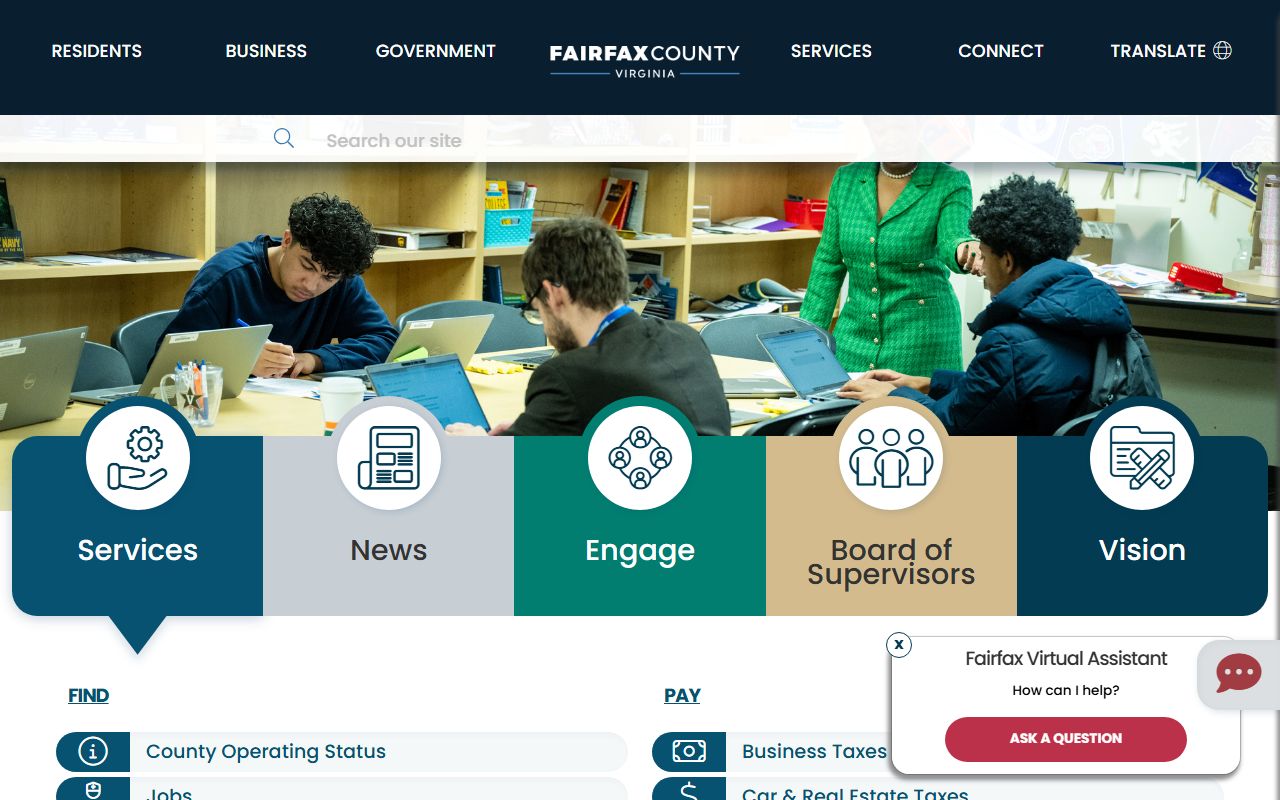
From the homepage, you can navigate directly to the Department of Tax Administration or use the site's search function to find specific property tax resources.
Tax Collection and Payment
The Department of Tax Administration also handles tax billing and collection in Fairfax County. Real estate taxes are billed twice a year, with one payment due in the first half of the year and a second in the second half. The department mails tax bills to the property owner of record, though mortgage companies often pay taxes directly from escrow accounts on behalf of homeowners.
Payment options include online payment through the county's portal, mail, in-person payment at the government center, and automatic bank draft enrollment. The DTA maintains records of all tax payments, delinquencies, and collection actions. If taxes go unpaid, the county can pursue collection through liens, delinquent tax sales, and other legal remedies. A delinquent tax lien stays with the property, not the owner, so buyers need to confirm a property's tax status before purchase.
The county's real estate search tool shows current tax balances and payment history for individual parcels. This is useful for anyone researching a property's financial standing before making an offer or completing a title search.
Below is a screenshot of the Department of Tax Administration's main page, which serves as the entry point for real estate assessments, tax payment, and related services in Fairfax County.
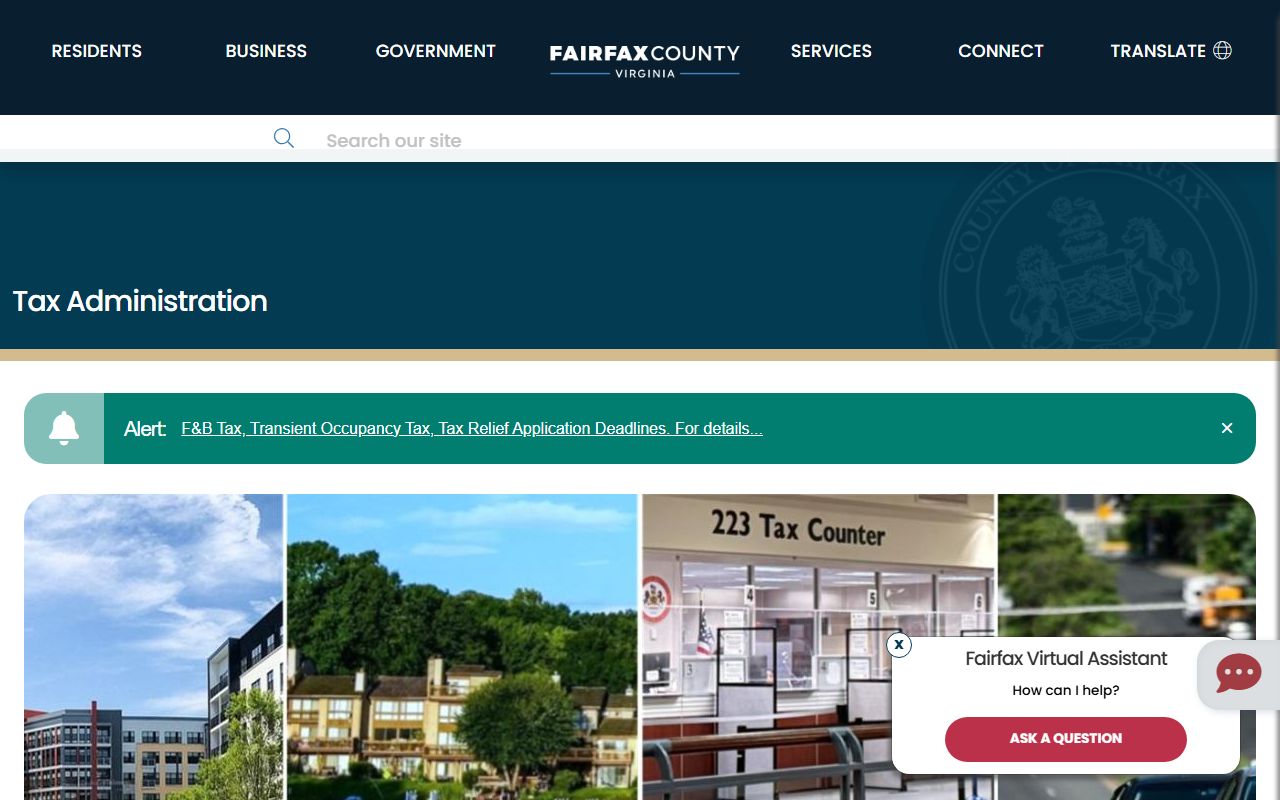
The page provides direct links to the real estate search portal, assessment appeals, and tax relief program applications.
How to Search Fairfax County Property Tax Records
The county's online real estate search portal is the most efficient way to look up property tax records in Fairfax County. The tool lets you search by property address, parcel identification number, or owner name. Search results show the current assessed value, prior year assessment, property details such as lot size and building square footage, sales history with dates and prices, and a link to view the full tax bill including any outstanding balance.
The portal also includes property photos for many parcels and links to comparable sales data that the county used when determining your property's value. This is particularly useful if you're thinking about filing an appeal. You can look at the sales the county relied on and decide whether they fairly represent your property's market value.
For records not available online, you can visit the Department of Tax Administration at the Fairfax County Government Center in Fairfax. Staff can pull records at the counter and provide printed copies. Under § 58.1-3331, these records are public, so no formal legal process is required to access basic assessment data. The Virginia Department of Taxation at tax.virginia.gov also explains the statewide rules governing public access to property tax records.
The county also maintains land books under § 58.1-3301, which list all taxable real property and the owners of record. These books are open for public inspection and provide a comprehensive snapshot of property ownership and assessed values in the county at any given point in time.
Real Estate Assessments in Fairfax County
Fairfax County reassesses all real property annually. This is less common in Virginia than biennial or quadrennial reassessment cycles used by smaller counties, but it reflects the size and complexity of Fairfax County's real estate market. Annual reassessment means your assessed value can change every year to reflect current market conditions. In a rising market, values tend to increase. In a cooling market, values may hold steady or drop.
The legal standard for assessments in Virginia is set by § 58.1-3200, which requires all real property to be assessed at 100% of fair market value. Fair market value is defined as the price a willing buyer would pay to a willing seller, with neither party acting under pressure. The county's mass appraisal models are built to approximate this standard across all parcels simultaneously rather than through individual appraisals.
If you believe your assessment does not reflect fair market value, Fairfax County offers a formal appeal process. The first step is an informal review with the DTA's assessment staff, which you can request online or by phone. If that does not resolve the dispute, you can file a formal appeal with the Board of Equalization. The Board holds hearings as set out under § 58.1-3379 and can order the DTA to change an assessment if the evidence supports it. Appeals must be filed within specific deadlines, which are noted on your assessment notice.
The Board of Equalization in Fairfax County operates under § 58.1-3378, which defines the board's authority, composition, and procedures. Hearings are open to the public, and property owners can present evidence such as independent appraisals, comparable sales data, or documentation of property condition to support their position.
The Virginia Code's real property assessment chapter explains the statewide framework that Fairfax County follows. The screenshot below shows the relevant code section at law.lis.virginia.gov.
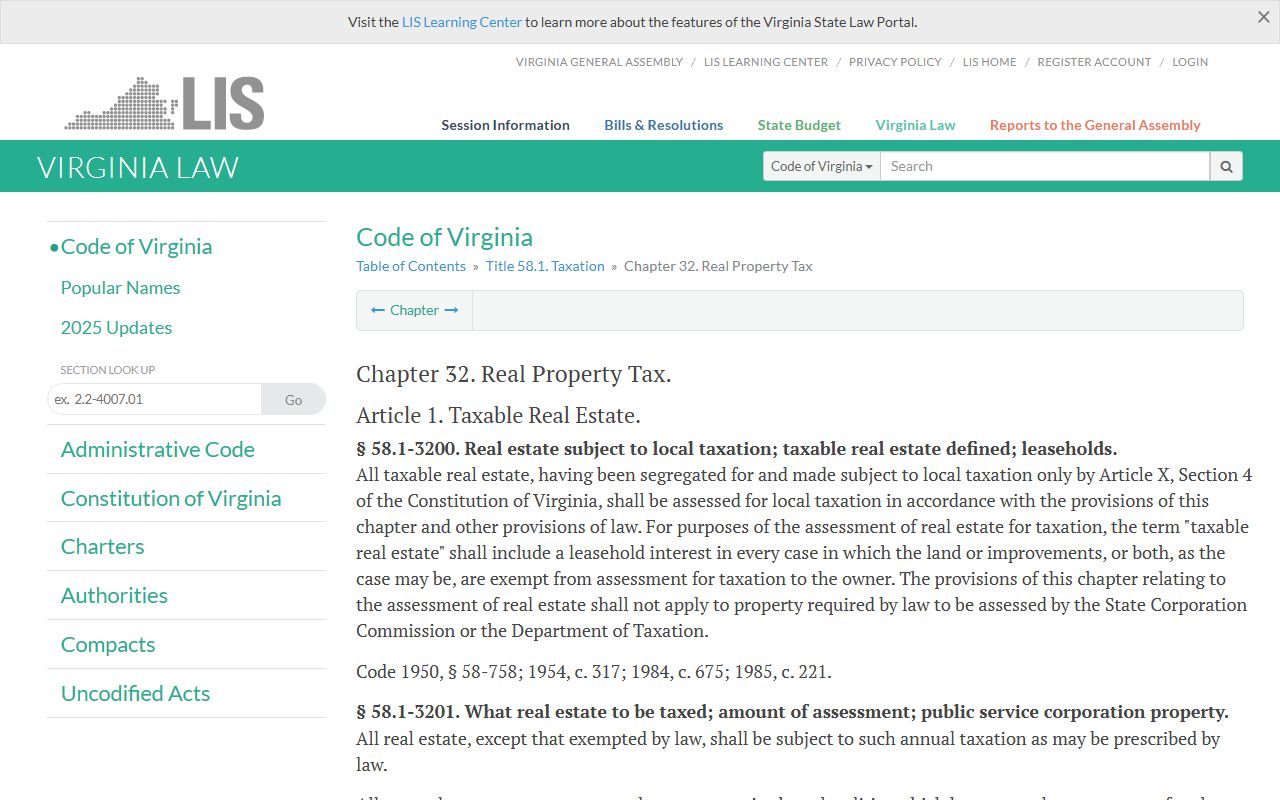
This code chapter governs how all Virginia localities, including Fairfax County, must assess and tax real property.
Tax Relief Programs
Fairfax County administers several tax relief programs for qualifying property owners. The largest is the elderly and disabled tax relief program, which can reduce or eliminate real estate taxes for qualifying owners who are 65 or older or permanently disabled and meet income and net worth limits. This program is authorized under § 58.1-3210, which allows localities to provide relief to residents on fixed or limited incomes.
Disabled veterans and surviving spouses of disabled veterans may qualify for a full exemption from real estate taxes under § 58.1-3219.5. This exemption applies to the veteran's primary residence and does not have income limits. Surviving spouses of veterans killed in action may also qualify. The DTA's website at fairfaxcounty.gov/taxes/property/tax-relief-programs lists current program details, eligibility criteria, and application forms.
The Virginia Department of Housing and Community Development at dhcd.virginia.gov also administers some statewide housing assistance programs that may help property owners facing financial hardship. While these are not direct property tax relief programs, they can help eligible residents maintain stable housing and manage housing costs more broadly.
Applications for tax relief in Fairfax County are typically due in the spring of each year. The DTA reviews applications and notifies applicants of their status. If you apply and are denied, you have the right to appeal the decision. Staff at the DTA can explain what documentation is needed and help walk you through the process.
Records Access and Public Inspection
Fairfax County property tax records are public under both Virginia law and county policy. The assessment records, land books, and tax bills maintained by the DTA are available for inspection by any member of the public under § 58.1-3331. No appointment is needed to view records in person, and the online portal provides 24-hour access to basic assessment and tax data.
The county's land books, required under § 58.1-3301, record every taxable parcel, the owner of record, and the assessed value. These are maintained as official public records. The Circuit Court clerk's office also holds deed records, which connect to the assessment records when ownership changes. Together, these records give a complete picture of who owns real property in Fairfax County and what it is assessed at for tax purposes.
For bulk data requests or records in specific formats, you can file a Virginia Freedom of Information Act request with the county. The county's FOIA officer can be reached through the county administrator's office. Response time is typically five business days, though the county may request an extension for complex requests involving large volumes of data.
Cities in Fairfax County
Several independent cities are geographically located within or adjacent to Fairfax County. These cities maintain their own separate governments and property tax systems, though they are closely connected to county services.
Nearby Counties
Fairfax County borders several other Northern Virginia counties. Each has its own property tax records system and Commissioner of the Revenue office.