
Smyth County Property Tax Records
Smyth County property tax records are maintained by the Commissioner of the Revenue and the Treasurer in Marion, covering all taxable real estate in this southwestern Virginia county. Assessment data, ownership details, and tax payment status are available through county offices or any online tools the county has made accessible to the public. Records show each parcel's owner of record, identification number, and assessed values for land and any structures on it. Property owners, buyers, and title researchers can all search Smyth County property tax records without restriction under Virginia's public access rules.
Smyth County Overview
Commissioner of the Revenue
The Smyth County Commissioner of the Revenue is the office responsible for assessing all real property and personal property in the county. Under Virginia Code Chapter 32, every parcel must be assessed at 100% of fair market value. The Commissioner keeps records of ownership, parcel identification numbers, legal descriptions, land and improvement values, and the full assessment history for each taxable property.
Smyth County's landscape spans the valleys and mountains of southwest Virginia. Real estate in the county includes residential homes in Marion and surrounding towns, agricultural tracts, mountain land, timber properties, and commercial parcels along major corridors. Each property type calls for a different approach to valuation. The Commissioner's office applies mass appraisal methods that meet standards the Virginia Department of Taxation sets statewide.
When ownership changes, the deed filed at the Circuit Court clerk's office in Marion triggers an update in the Commissioner's records. New owners should verify that records reflect the change accurately. If the records still show the prior owner or an incorrect value, the Commissioner's staff can look into it and make corrections where warranted.
Under § 58.1-3330, the county must give written notice to property owners when assessments increase past a set level. If you get one of those notices, contact the Commissioner's office to get an explanation of how the value was determined. This is also the right time to ask about your appeal options if you think the new value is too high.
The Commissioner's office is located in Marion. Current hours and contact information can be found at smythcounty.org. Calling ahead before a visit is a smart move, particularly if you want to review appraisal records or meet with assessment staff.
Smyth County Treasurer
The Smyth County Treasurer collects real estate taxes and personal property taxes based on values certified by the Commissioner of the Revenue. The Treasurer sends out tax bills, accepts payments by several methods, and handles collection actions on delinquent accounts. Tax bills generally go out twice a year in Virginia, with due dates the county board of supervisors sets annually.
Unpaid real estate taxes in Smyth County create a lien on the property. That lien stays with the land, not just with the owner who owed the debt. Anyone buying property in the county should confirm with the Treasurer that no outstanding taxes are owed before closing. Title companies do this as part of their standard process, but verifying it independently is wise.
The Treasurer's office can issue receipts and confirm whether a property's taxes are current. Disputes over the amount of a tax bill need to start with the Commissioner's office, since the Treasurer can only collect what the Commissioner certifies. Changes to the assessed value have to come through the Commissioner before a bill can be adjusted.
For current payment options and due dates in Smyth County, check the county website or call the Treasurer's office in Marion. Online payment may be available. Ask staff about any convenience fees that apply to card or online payments.
How to Search Smyth County Property Tax Records
To find property tax records in Smyth County, start at the official county website at smythcounty.org. Look for links to an online property search portal through the Commissioner of the Revenue or GIS sections. Some Virginia counties use third-party assessment software with a public search tool that lets you look up parcels by owner name, address, or parcel number. Check whether Smyth County has this option active.
If no online tool is available, or if you need more detailed records, visit the Commissioner's office in Marion. Under § 58.1-3331, assessment records are open for public inspection. No stated reason is needed. Staff can pull up files by address, parcel number, or owner name. Copies are generally available for a per-page fee.
Virginia's Freedom of Information Act allows you to request records in writing. FOIA requests for tax assessment data should go to the county administrator's office in Marion. The county has five business days to respond, with possible extensions for large or complex requests. This route works well when you need records in bulk or in a specific format.
Older land records and historical data may be held at the Smyth County Circuit Court clerk's office or at the Library of Virginia in Richmond. The Library maintains digitized records from many Virginia counties, which is useful when tracing property ownership over longer time periods.
Assessment Process
Virginia law under Code Chapter 32 requires every locality to assess real property at 100% of fair market value. Smyth County follows this rule. The Commissioner uses mass appraisal methods to value all parcels on a general reassessment cycle. Values can also change between reassessments when properties sell, when new construction is added to the tax roll, or when errors are discovered and fixed.
The appraisal card for each parcel documents the physical data used to set the value. This includes lot size, building square footage, year built, construction type, condition rating, and any additions or outbuildings. Under § 58.1-3332, property owners have the right to inspect their own appraisal card. If the card contains errors, such as wrong square footage or features the property doesn't have, pointing those out to the Commissioner's office can lead to a corrected assessment.
Appeals go to the Board of Equalization when you and the Commissioner disagree on a value. Under § 58.1-3378, every Virginia county must maintain a Board of Equalization to hear such disputes. The board can reduce, raise, or leave an assessment unchanged based on the evidence presented. Hearing procedures are governed by § 58.1-3379. Comparable sales data for similar properties is typically the strongest evidence to bring to a board hearing.
The Virginia Department of Taxation at tax.virginia.gov publishes guidance on how local assessment systems work statewide.
The screenshot below shows the Virginia Department of Taxation website, the state agency that sets assessment standards localities like Smyth County must follow.
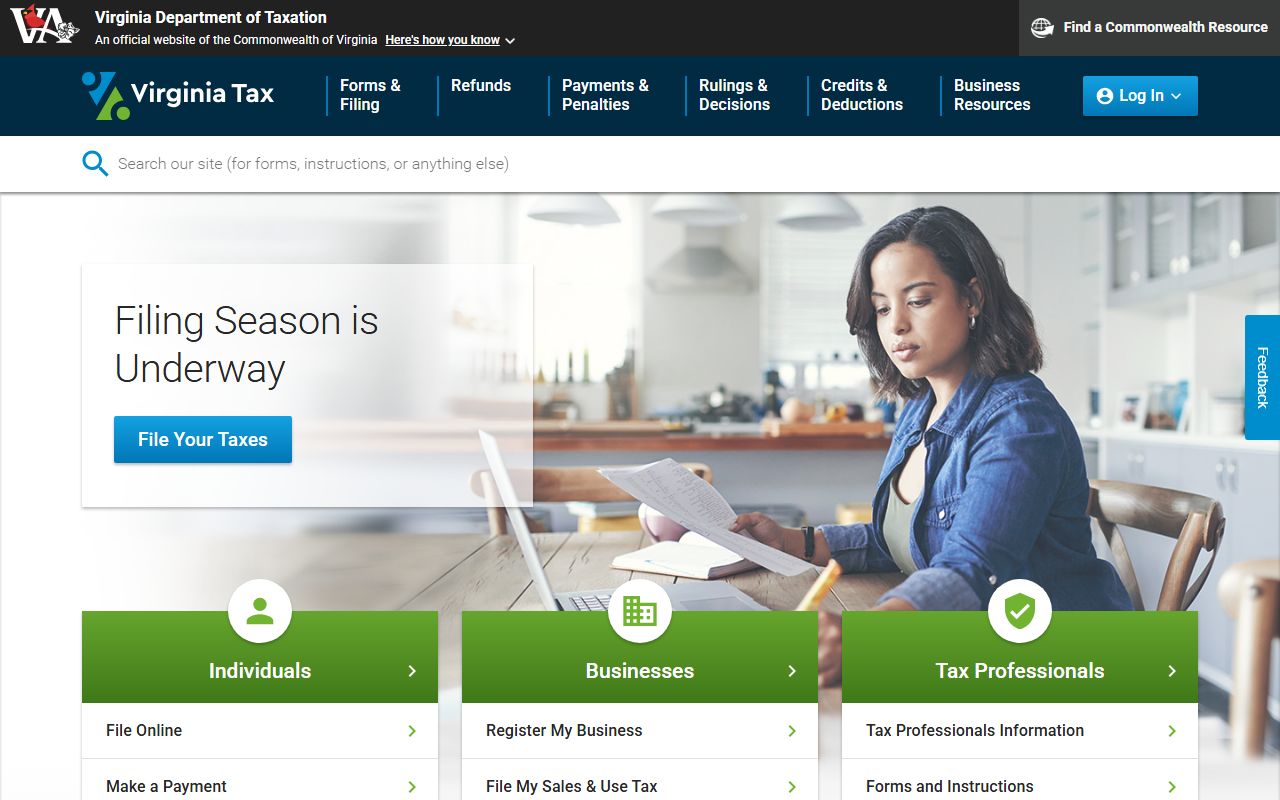
The Virginia Department of Taxation provides the framework that guides how Smyth County assesses and records real property values.
Tax Relief Programs
Smyth County offers property tax relief to elderly and disabled homeowners under Virginia Code § 58.1-3210. You must meet age or disability criteria, own and live in the home as your primary residence, and fall within the income and net worth limits set by the county. Contact the Commissioner's office for the current year's eligibility thresholds.
Veterans who have a total and permanent service-connected disability may qualify for a full real estate tax exemption on their primary home under § 58.1-3219.5. The surviving spouses of veterans killed in action may also be eligible. The Commissioner's office handles these applications and will tell you what documentation the U.S. Department of Veterans Affairs needs to provide.
The Virginia Department of Housing and Community Development at dhcd.virginia.gov runs programs that may work alongside Smyth County's local relief options. If paying property taxes is a hardship, look at what both the county and DHCD can offer.
The image below shows the Virginia DHCD website, which coordinates state housing programs that can supplement local tax relief for eligible residents.
DHCD programs can work alongside local Smyth County relief options for qualifying homeowners.
Land Books and Records Access
Under Virginia Code § 58.1-3301, Smyth County's Commissioner must keep a land book that lists every taxable parcel, the owner of record, the assessed value, and the taxes due. This is a public record anyone can inspect at the Commissioner's office in Marion during business hours. You don't need to explain why you want to see it.
Land books serve many uses. Title examiners check them to spot outstanding tax obligations before a sale closes. Researchers trace ownership histories over time using successive land book entries. Property owners can compare their parcel's data to nearby properties to see if their assessment looks consistent. These books capture who owned what land and what it was worth at a given time.
Older land books from Smyth County are likely held at the Circuit Court clerk's office in Marion and at the Library of Virginia in Richmond. The Library of Virginia has digitized some historical Virginia property records, including land books from past centuries. Reaching out to both offices helps you locate exactly where the records you need are kept.
Assessment records under § 58.1-3331 are open to the public without cause. Per-page copy fees typically apply. The Circuit Court clerk's office also holds deeds and plats that provide legal detail that tax records alone won't contain. Using both together gives the fullest view of any parcel's history in Smyth County.
Cities in Smyth County
Smyth County does not contain any independent cities. Marion is an incorporated town and the county seat, but it operates as a town under Virginia law rather than as an independent city.
Nearby Counties
Smyth County is located in southwest Virginia and shares borders with several neighboring counties. Links to nearby county property tax record pages are listed below.