
Search Page County Property Tax Records
Page County property tax records are kept by the Commissioner of the Revenue and the Treasurer, both located in Luray in Virginia's Shenandoah Valley. These records cover all taxable real estate in the county, and residents can find assessment data, owner details, and payment history through county offices or any online access tools the county provides. Each parcel record includes the owner's name, a parcel identification number, and values for land and any improvements. Property owners, buyers, and title researchers can look up any parcel in Page County as all assessment data is open to the public under Virginia law.
Page County Overview
Commissioner of the Revenue
The Page County Commissioner of the Revenue assesses all real property in the county at fair market value, as required under Virginia Code Title 58.1, Chapter 32. The office also handles personal property assessments, maintains individual parcel records, and administers tax relief programs for eligible residents.
Records this office keeps include the owner of record, parcel identification number, legal description, land and building values, and assessment history. When a parcel sells or changes hands, the deed recorded at the Circuit Court clerk's office triggers a file update with the Commissioner. New construction and improvements made to existing structures also feed into assessment updates.
The Commissioner's office is in Luray at the county government building. Standard hours are Monday through Friday during business hours. It's smart to call ahead to confirm times before visiting. Staff can explain how a specific property was valued and what comparable data was used to set the figure.
Under § 58.1-3330, the county is required to notify property owners when assessments change above a set threshold. If you get such a notice, the Commissioner's office is where you should start. They can explain the methodology and help you understand your options.
The Virginia Department of Taxation at tax.virginia.gov provides statewide context for how local commissioners operate and what records they must maintain. That's useful background reading before you contact the local office.
Page County Treasurer
The Page County Treasurer collects real estate and personal property taxes based on values the Commissioner of the Revenue sets. The office also manages delinquent collections and handles payments made in person, by mail, or online where that option is offered.
Tax bills in Page County are typically issued twice a year. The Treasurer's records show whether taxes on any given parcel are current, past due, or under collection action. Anyone buying property here should confirm with the Treasurer that no back taxes are owed. Delinquent real estate taxes are a lien on the property. That lien follows the land, not the owner, so it must be cleared before a clean title transfers.
If the amount on your tax bill seems wrong, the Treasurer will point you to the Commissioner's office. Adjustments to bill amounts require the Commissioner to first correct the underlying assessment. The Treasurer can confirm payment status, give you receipts, and answer questions about deadlines and payment options.
Page County residents who are having trouble keeping up with taxes should ask the Treasurer's office about any local assistance or payment plan options. Some options exist that are not broadly publicized and may help owners avoid falling into delinquency.
How to Search Page County Property Tax Records
Start at the county's official website at pagecounty.virginia.gov and look for links to any property search portal the county makes available. Some Virginia localities use third-party assessment software with public web portals. These let you search by owner name, parcel ID, or street address and view current assessment data, property details, and recent sales.
If no online portal is active or you need records not available online, contact the Commissioner of the Revenue directly. Under Virginia Code § 58.1-3331, all assessment records are open for public inspection. You don't have to give a reason or hold any interest in the property to look at them. Staff can retrieve records at the counter, and copies are available for a small per-page charge.
Virginia's Freedom of Information Act also lets you request records in bulk or in specific formats. Direct written FOIA requests to the county administrator's office. Replies are due within five business days, though extensions are allowed for large or complex requests.
The Page County Circuit Court clerk's office in Luray holds deed records, plats, and other land documents that pair well with tax data. Combining deed records and Commissioner data gives you a full picture of any parcel's ownership history and legal description. Both offices are accessible through the county's main website.
Assessment Process
Virginia law under § 58.1-3200 requires all real property to be assessed at 100% of fair market value. Page County follows this standard. The Commissioner uses mass appraisal techniques to value the county's varied mix of residential homes, mountain properties, agricultural land, and commercial parcels along the valley floor. Page County's geography, nestled between the Blue Ridge and Massanutten mountains, means terrain plays a role in how parcels are valued.
Each parcel's appraisal file includes lot size, building square footage, year built, construction type, number of rooms, and any improvements like outbuildings or major renovations. Under § 58.1-3332, you have the right to inspect your own appraisal card. That card lists the data used to reach your assessed value. Errors in the property description can sometimes lead to a revised value once corrected.
If you disagree with your assessment and talks with the Commissioner don't resolve it, you can appeal to the Board of Equalization. Under § 58.1-3378, each county must maintain a Board of Equalization to hear such appeals. The board operates independently from the Commissioner and can order an assessment lowered, raised, or left alone. Hearing rules are governed by § 58.1-3379.
Rural and mountain land in Page County may also qualify for use-value assessment under the land use program. This taxes land based on its current agricultural, horticultural, forest, or open-space use rather than its full development value. Ask the Commissioner's office if any of your parcels might be eligible.
The image below shows the Virginia Department of Taxation website, which provides statewide guidance on assessment standards that all local commissioners must follow.
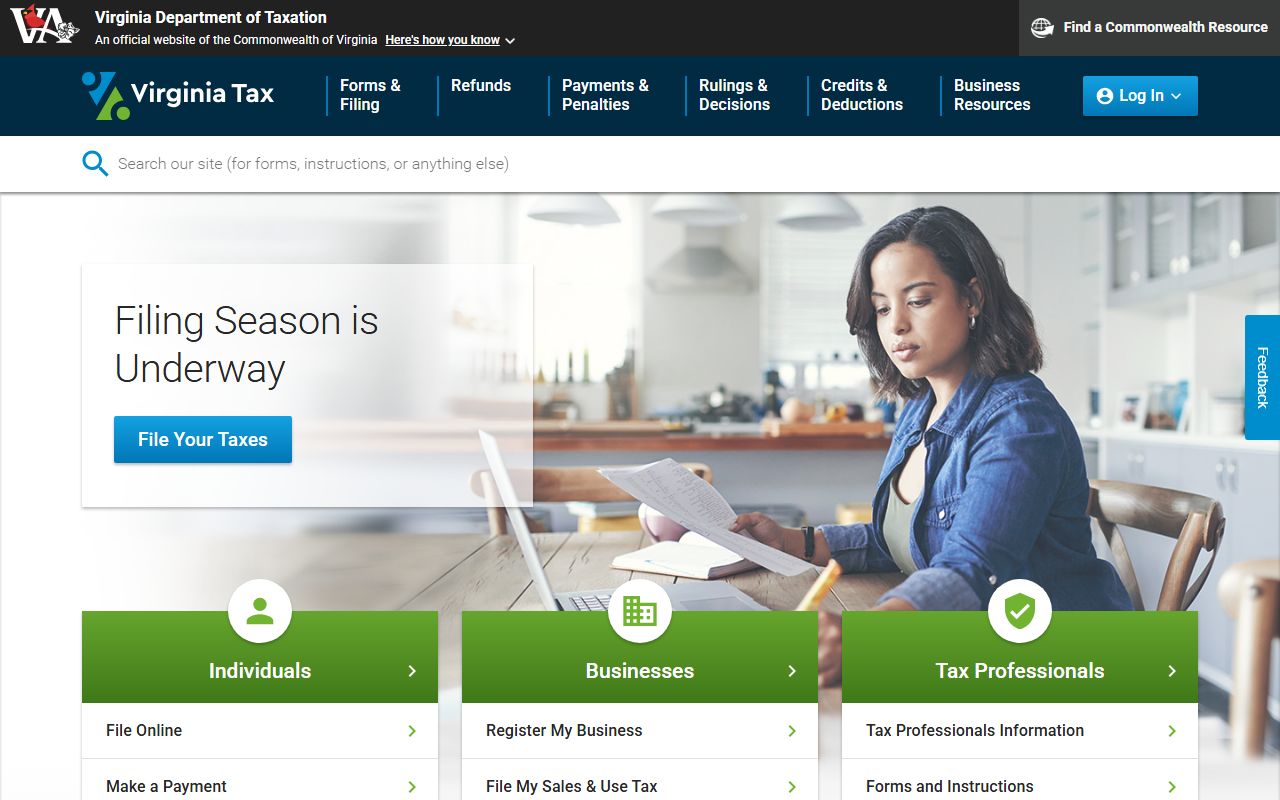
The Virginia Department of Taxation oversees uniform assessment standards across all localities in the state.
Tax Relief Programs
Page County provides tax relief to qualifying elderly and disabled property owners under Virginia Code § 58.1-3210. To be eligible, you must meet age or disability requirements, own and occupy the home as your primary residence, and stay within income and net worth limits set by the county. Those limits can be adjusted year to year, so check with the Commissioner of the Revenue for the most current numbers before applying.
Disabled veterans and surviving spouses of service members killed in action may qualify for a full real estate tax exemption under § 58.1-3219.5. This applies to the primary residence and requires certification of total and permanent service-connected disability from the U.S. Department of Veterans Affairs. The Commissioner's office processes these applications and can describe the paperwork required.
The land use program allows owners of farmland, forest land, or open-space parcels to be taxed at use value rather than full market value. This can reduce the tax burden on large rural tracts considerably. Applications must be filed by a deadline each year, so ask the Commissioner about the process if you think any of your property qualifies.
The Virginia Department of Housing and Community Development at dhcd.virginia.gov runs statewide programs that can work alongside local tax relief. If property taxes are a hardship in Page County, look at both local programs and what DHCD may offer at the state level.
The image below shows the DHCD website, a resource for housing assistance and tax relief programs available to Virginia residents.

DHCD programs can supplement local options for Page County residents who qualify under state eligibility rules.
Land Books and Records Access
Under Virginia Code § 58.1-3301, each county commissioner must maintain a land book that lists every parcel, its owner, the assessed value, and the tax owed. These land books are public records. Anyone can review them at the Commissioner's office during business hours without having to show a reason for the request.
For Page County, land books are useful for tracing ownership at a specific point in time, confirming assessment values, and checking tax status. Researchers, title examiners, and property owners all use them. Older land books may be stored at the courthouse or at the Library of Virginia, which preserves historical records from across the state.
Assessment records under § 58.1-3331 are open to the public without restriction. You can walk into the Commissioner's office and ask to see records for any parcel in Page County. No appointment is needed, though calling ahead is still a good idea. Copies are available for a per-page fee, and staff can help you navigate the records.
The Circuit Court clerk's office in Luray holds deeds, plats, wills, and related land documents that complement tax records. Using both sources together gives you the most complete picture of a property's history and legal status. Page County's history goes back to 1831, giving researchers a rich record base to work from.
Cities in Page County
Page County does not contain any independent cities. Luray serves as the county seat and is a town rather than an independent city under Virginia law.
Nearby Counties
Page County is located in the Shenandoah Valley and shares borders with several surrounding counties.