
Search Gloucester County Property Tax Records
Gloucester County property tax records are maintained by two offices at the county courthouse in Gloucester Court House: the Commissioner of the Revenue, which handles assessments, and the Treasurer, which collects taxes. Residents and researchers can access parcel data, assessment history, and tax status through these offices or through the county's online resources at gloucesterva.gov. Records include owner names, parcel identification numbers, assessed land and improvement values, and tax payment history for all taxable real property in Gloucester County. Property owners, buyers, and the general public can search any parcel, as Virginia law requires all assessment records to be open for public inspection.
Gloucester County Overview
Commissioner of the Revenue
The Gloucester County Commissioner of the Revenue is the primary office for real estate assessment records on the Middle Peninsula. This elected official assesses all taxable real property in the county at 100% of fair market value, as required under Virginia Code § 58.1-3200. Records maintained by the Commissioner include owner name and address, parcel identification number, legal description, land and improvement values, total assessed value, and assessment history for every parcel in Gloucester County.
Gloucester County sits on Virginia's Middle Peninsula between the Piankatank River to the north and the York River to the south. The county's coastal and waterfront character means many properties have water access or water views that affect their market value. Waterfront and water-oriented properties often command premium prices, and the Commissioner's office accounts for these location factors when assessing parcels near tidal waters and creeks. Inland properties are assessed using the same 100% fair market value standard but without the water-access premiums that affect coastal parcels.
When properties sell in Gloucester County, the deed recorded at the Circuit Court clerk's office triggers a review of the parcel in the Commissioner's files. Ownership records are updated to reflect the new buyer, and if the sale price suggests the current assessment is significantly off from market value, a reassessment may follow. The Commissioner also keeps records of physical changes to properties, such as new construction or major improvements, that affect assessed values.
Assessment notices go out when values change, as required by § 58.1-3330. These notices provide the old and new assessed values and explain the appeal process. The Commissioner's office at the Gloucester County courthouse can answer questions about how any parcel was assessed and what data was used to determine the value.
The Gloucester County official website connects residents with all county departments, including the Commissioner's office and online property tools. The image below shows the county's official government site.

From the county homepage, you can navigate to the Commissioner's office, Treasurer, GIS mapping portal, and other property-related resources.
Gloucester County Treasurer
The Gloucester County Treasurer collects real estate taxes and personal property taxes based on assessments certified by the Commissioner of the Revenue. The Treasurer processes payments, manages delinquent accounts, and keeps records of all tax transactions for every parcel in the county. If you need to verify current tax status on a property or get confirmation of prior payments, the Treasurer's office is where you go.
Gloucester County issues real estate tax bills on a schedule set by the county. Bills are mailed to property owners at the address on file with the Commissioner. Homeowners with mortgage escrow accounts generally have taxes paid by their servicer, but verifying that payments are made on schedule is a good practice. Unpaid taxes accrue penalties and interest, and delinquent balances become a lien on the property itself. Any lien must be cleared before a property can change hands with a clean title.
The Treasurer's office accepts payments in person during business hours, by mail, and through online payment options if the county provides them. Check the county website at gloucesterva.gov for current information on payment methods, hours, and any online tools. The Treasurer can also provide certificates of tax paid or statements of current balance, which are commonly needed for real estate closings in the county.
How to Search Gloucester County Property Tax Records
Gloucester County offers online property search and GIS tools through the county's official website. The GIS mapping portal lets you search for parcels on an interactive map by address or parcel identification number. GIS tools show parcel boundaries, ownership data, and property characteristics. Many county GIS portals link directly to assessment records or provide the parcel ID needed to look up tax and payment data in other county systems.
For comprehensive assessment data and payment history, check the county website for any online property search portal linked from the Commissioner's or Treasurer's pages. Online tools typically let you search by owner name, address, or parcel number and view current and historical assessment data, tax bill amounts, and payment status. If an online tool is available in Gloucester County, it will be accessible through the county's website at gloucesterva.gov.
For records not available online or when you need more detail, visit the Commissioner's office in person. Under § 58.1-3331, assessment records are open for public inspection during regular business hours. Staff can pull up records at the counter for any parcel. No special request or legal justification is needed to view basic assessment data. Printed copies are available for a small fee.
Virginia's Freedom of Information Act provides another route for accessing records, particularly in bulk or in specific formats. Written FOIA requests go to the county administrator's office in Gloucester Court House. The county must respond within five business days, though extensions may apply for large or complex requests. For routine property lookups, contacting the Commissioner directly is usually faster.
Assessment Standards and Appeals
All taxable real property in Gloucester County must be assessed at 100% of fair market value under § 58.1-3200. The Commissioner uses sales data from comparable properties to calibrate values. In Gloucester County, where waterfront and near-water properties often sell at significant premiums over inland properties, the assessment model must account for these location-based differences while still reflecting what each individual parcel would sell for on the open market.
If you believe your Gloucester County assessment is too high, start with an informal review at the Commissioner's office. Bring evidence such as a recent independent appraisal or data on sales of comparable properties. Physical errors in the county's records, such as incorrect lot size, wrong square footage, or misclassified property type, can also justify a correction. Many appeals are resolved at the informal stage.
If the informal review does not resolve the issue, file a formal appeal with the Board of Equalization. The Board hears appeals under § 58.1-3379 and operates under § 58.1-3378. Board members review evidence and can order assessment changes if the data supports it. Filing deadlines are listed on assessment notices, and missing them means waiting until the next assessment cycle.
The Virginia real property assessment statutes set the standards Gloucester County follows. The image below shows the relevant code section at law.lis.virginia.gov.
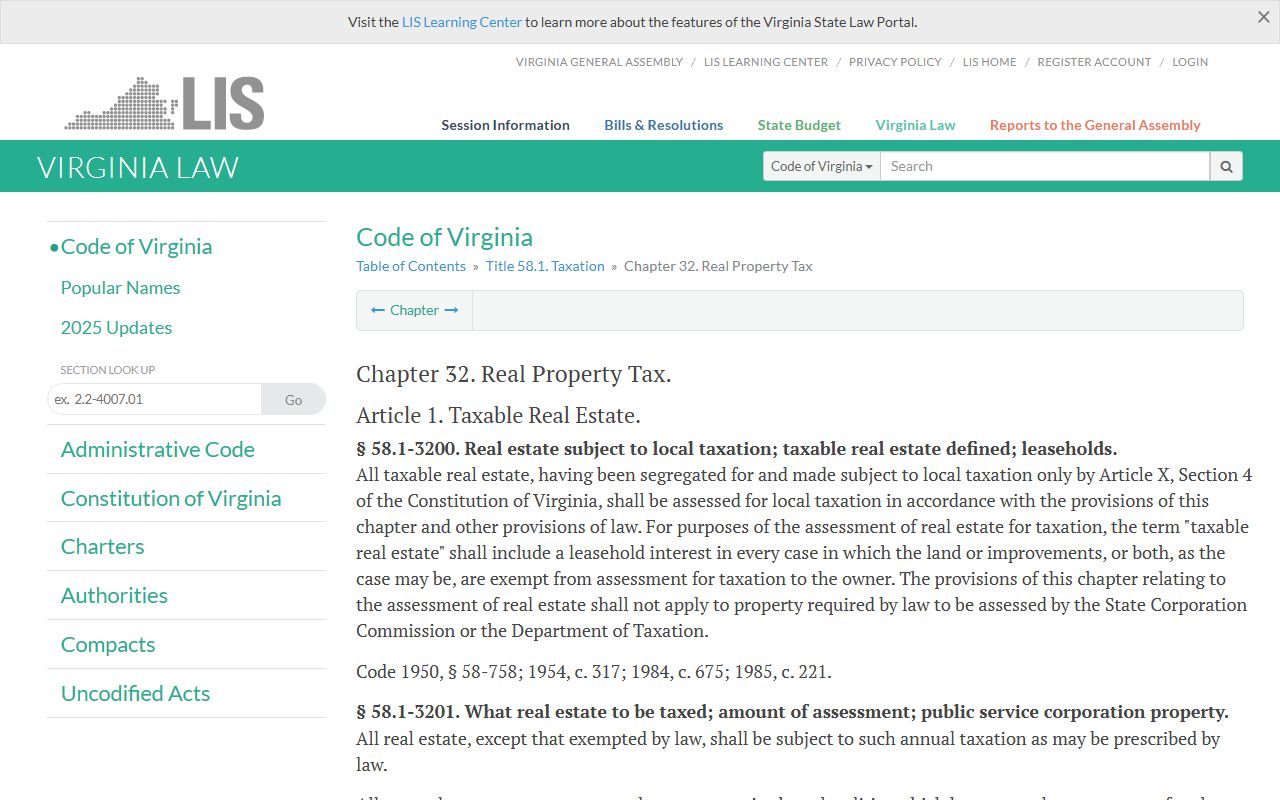
This code chapter governs real estate assessment and appeals throughout Virginia, including Gloucester County on the Middle Peninsula.
Tax Relief Programs
Gloucester County offers real estate tax relief for qualifying elderly and disabled residents under § 58.1-3210. The program can reduce or eliminate real estate taxes for owners who are 65 or older or permanently disabled and who meet income and net worth limits the county sets annually. Applications are filed with the Commissioner of the Revenue by a deadline each year. Eligible residents should apply promptly to ensure relief is applied to the current year's tax bill.
Veterans with a 100% service-connected disability rating and their surviving spouses may qualify for a full real estate tax exemption on their primary residence under § 58.1-3219.5. This exemption has no income limit. The Commissioner's office handles applications and can explain what documentation is required, typically a letter from the U.S. Department of Veterans Affairs confirming the disability rating and a statement that the property is the veteran's primary residence.
The Virginia Department of Housing and Community Development at dhcd.virginia.gov administers statewide programs that may provide additional assistance for homeowners facing housing cost pressures. These programs are separate from local tax relief but can complement them for residents who qualify for multiple forms of help. Agricultural land in Gloucester County may also qualify for the land use taxation program, which assesses working farmland at use value rather than market value.
Records Access and Land Books
All real estate assessment records in Gloucester County are public under § 58.1-3331. The Commissioner of the Revenue makes these records available for inspection at the county courthouse in Gloucester Court House. No fee is required to view records in person, and no reason needs to be given. The records include all parcel data, assessment history, and ownership information maintained by the Commissioner's office.
Under § 58.1-3301, the Commissioner must maintain land books listing all taxable property in the county, the owner of record, and the assessed value. These books are public records and available for inspection at the office. Title companies, attorneys, and researchers use land books regularly to check ownership and assessment history. The Circuit Court clerk's office holds deed records, which complement the land books by documenting ownership transfers and sale details.
The Virginia Department of Taxation at tax.virginia.gov explains the broader framework of property assessment and taxation in Virginia. If you want context for how Gloucester County's system works within the state's structure, the state tax department's site provides useful background on assessment standards, appeal rights, and public access to property records.
Cities in Gloucester County
Gloucester County does not contain any independent cities. Gloucester Court House is the county seat and location of county government offices.
Nearby Counties
Gloucester County borders several counties in the Tidewater and Middle Peninsula regions of Virginia. Each has its own property tax records and Commissioner of the Revenue.