
Charles City County Real Estate Tax Records
Charles City County property tax records are kept by the Commissioner of the Revenue and the Treasurer, both based in Charles City, the county seat. Situated between Richmond and Williamsburg along the James River, Charles City County maintains these records as public documents open to anyone seeking assessment values, ownership information, or tax status for parcels within the county. Each parcel record includes the owner name, parcel identification number, assessed land and improvement values, and tax payment history. Property owners, buyers, and title researchers can access Charles City County property tax records by visiting the county offices directly or by submitting a written records request.
Charles City County Overview
Commissioner of the Revenue
The Charles City County Commissioner of the Revenue assesses all real property in the county at fair market value as required by Virginia Code § 58.1-3200. The Commissioner maintains a record for each parcel that includes the owner's name, the parcel identification number, the legal description, and the assessed values for land and improvements separately. These records are used to generate the annual tax levy and are updated throughout the year as properties change hands or as new construction is completed.
Charles City County is a rural county with a significant amount of agricultural and timberland. The Commissioner uses appropriate assessment methods for different property types, including use-value assessment for qualifying farmland and forestland under state programs. If you own agricultural land in Charles City County and are interested in whether it qualifies for a reduced assessment, the Commissioner's office is where you start that inquiry. Use-value assessment can significantly reduce the tax burden on qualifying land.
The Commissioner's office is located at the county government complex in Charles City. Because the county is relatively small, the staff can often handle inquiries quickly, but calling ahead to confirm hours is wise. When properties sell in Charles City County, the deed recorded at the Circuit Court notifies the Commissioner to update ownership records. The Circuit Court and Commissioner's office work in a coordinated way to keep assessment files current.
When the county runs a general reassessment, owners get written notice under § 58.1-3330 if their value increases significantly. That notice explains how to request a review. Resolving assessment questions early, before formal appeal deadlines pass, is always the better approach.
Charles City County Treasurer
The Charles City County Treasurer collects real estate taxes based on assessed values set by the Commissioner. The Treasurer also handles personal property tax collections and manages delinquent accounts. Tax bills are typically issued twice a year in Virginia counties, and Charles City County follows this schedule. Current due dates are posted on the county website at charlescityva.us.
The Treasurer's payment records are public and show whether a parcel's taxes are paid or delinquent. If you are purchasing property in Charles City County, the closing will include a review of the Treasurer's records to confirm there are no outstanding tax liabilities. Delinquent real estate taxes are liens on the property that must be paid before a clean title can change hands. The Treasurer can provide a written tax status certification for any parcel in the county.
For questions about why a tax bill looks different from last year, the Commissioner's office is the first stop. The Treasurer can only change a bill if the Commissioner first adjusts the assessment. But for receipts, payment history, and current balance questions, the Treasurer's office handles those directly. The office is accessible through the county's main website.
The Virginia Department of Taxation at tax.virginia.gov provides a general guide to how local property tax collection works in Virginia.
Searching Property Tax Records
Visit the Charles City County website at charlescityva.us to look for any online property search portal. Some Virginia counties offer vendor-hosted tools that allow the public to search assessment records by owner name, parcel ID, or address. If such a tool is active in Charles City County, you can access basic assessment data without making the trip to Charles City. Check the departments section of the county website for links.
If no online portal is available, contact the Commissioner of the Revenue's office directly. Under Virginia Code § 58.1-3331, all assessment records must be open for public inspection at the county's offices. You do not need a stated reason for wanting access. Staff can look up parcel records at the counter, and you can request copies for a small fee. In-person visits are especially useful for older rural parcels that may not appear in online databases.
The Circuit Court Clerk's office in Charles City also holds deed records and plat maps that complement assessment files. Together, these two sets of records provide a fairly complete picture of any parcel's ownership and legal history. Both offices are in the county government complex in Charles City.
How Assessments Work
All real property in Charles City County must be assessed at 100 percent of fair market value under § 58.1-3200. The Commissioner of the Revenue determines fair market value using comparable sales data, property inspections, and information about each parcel's physical characteristics and land use. The standard is what a willing buyer would pay a willing seller in a transaction free from unusual pressures or special circumstances.
Virginia requires counties to conduct general reassessments at least once every six years. Between those formal reassessment cycles, the Commissioner updates individual parcels when new information is available, such as a property sale, new construction, or a demolition. This ongoing process keeps the tax roll reasonably accurate across the full reassessment cycle and prevents large, sudden shifts when a new general reassessment takes place. In Charles City County, where the market is influenced by its rural character and proximity to the Richmond and Hampton Roads areas, regular updates matter.
If you think your assessed value is too high, start with the Commissioner's office and ask how the value was set. If you still disagree, you can appeal to the Board of Equalization under § 58.1-3378. Under § 58.1-3379, the Board must hold a hearing and let you present evidence. A licensed appraisal or documentation of comparable sales supporting a lower value gives you the strongest case at a Board hearing.
The image below shows the Virginia Department of Taxation's property tax overview, which applies to Charles City County and all other Virginia localities.
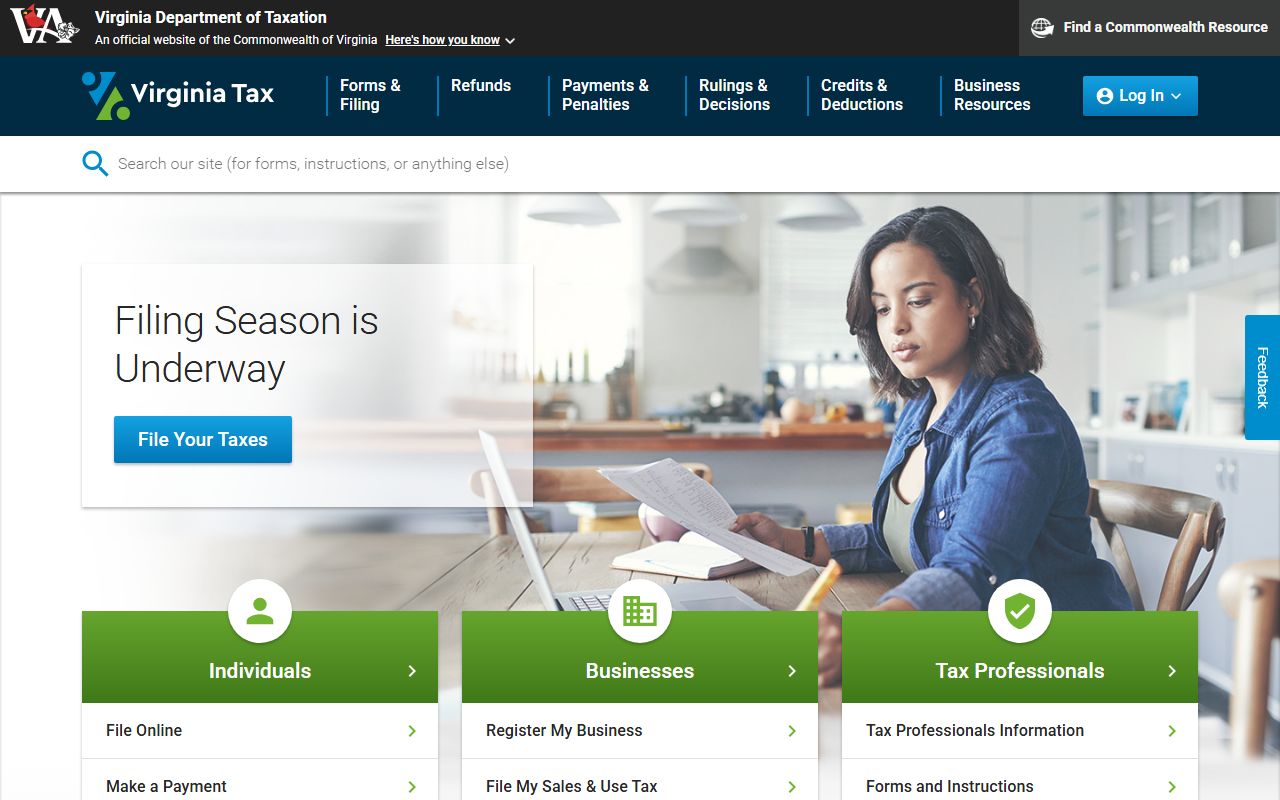
The full resource is available at tax.virginia.gov.
Tax Relief for Qualifying Residents
Charles City County administers a real estate tax relief program for elderly and disabled homeowners under Virginia Code § 58.1-3210. Eligible residents who own and occupy their home as a primary residence and meet the county's income and age thresholds may receive a partial or full exemption from real estate taxes. The Commissioner of the Revenue administers applications. Contact the office directly to get the current income limits and the application form. Applying before the county's annual deadline is important to make sure the relief is applied to your bill for the current tax year.
Virginia's veterans' exemption under § 58.1-3219.5 allows veterans who have a 100 percent total and permanent disability rating from the VA to receive a full exemption from real estate taxes on their primary residence. The surviving spouse of a veteran who qualified for this exemption may also be eligible to continue receiving it, subject to conditions under state law. Bring documentation of your VA rating and proof of residency and ownership to the Commissioner's office to apply.
The Virginia Department of Housing and Community Development at dhcd.virginia.gov offers programs that can help low-income homeowners with property-related costs, including taxes. These state programs may supplement the local relief options available through Charles City County's Commissioner of the Revenue.
Land Books and Public Records Access
Virginia law under § 58.1-3301 requires the Commissioner of the Revenue to maintain a land book for the county. This is a comprehensive public record listing every parcel of real property in Charles City County, its owner, and its assessed value. The land book is open for inspection at the Commissioner's office without charge, though copying fees apply. Historical land books can be a valuable research resource for anyone studying how land ownership and values have changed over time in the county.
Charles City County has a deep history of land grants and large agricultural tracts that have been subdivided over generations. The land book records this ongoing process, year by year. Title researchers and historians sometimes find that land books fill in gaps that deed records alone cannot. By checking land book entries over a span of years, you can often identify when ownership of a specific tract changed or when a parcel was first separated from a larger holding.
Under § 58.1-3331, all assessment records must be open to public inspection. This means any person can walk into the Commissioner's office in Charles City and ask to review land book records for any parcel in the county.
The image below is from the Virginia Code section that establishes the land book requirement.
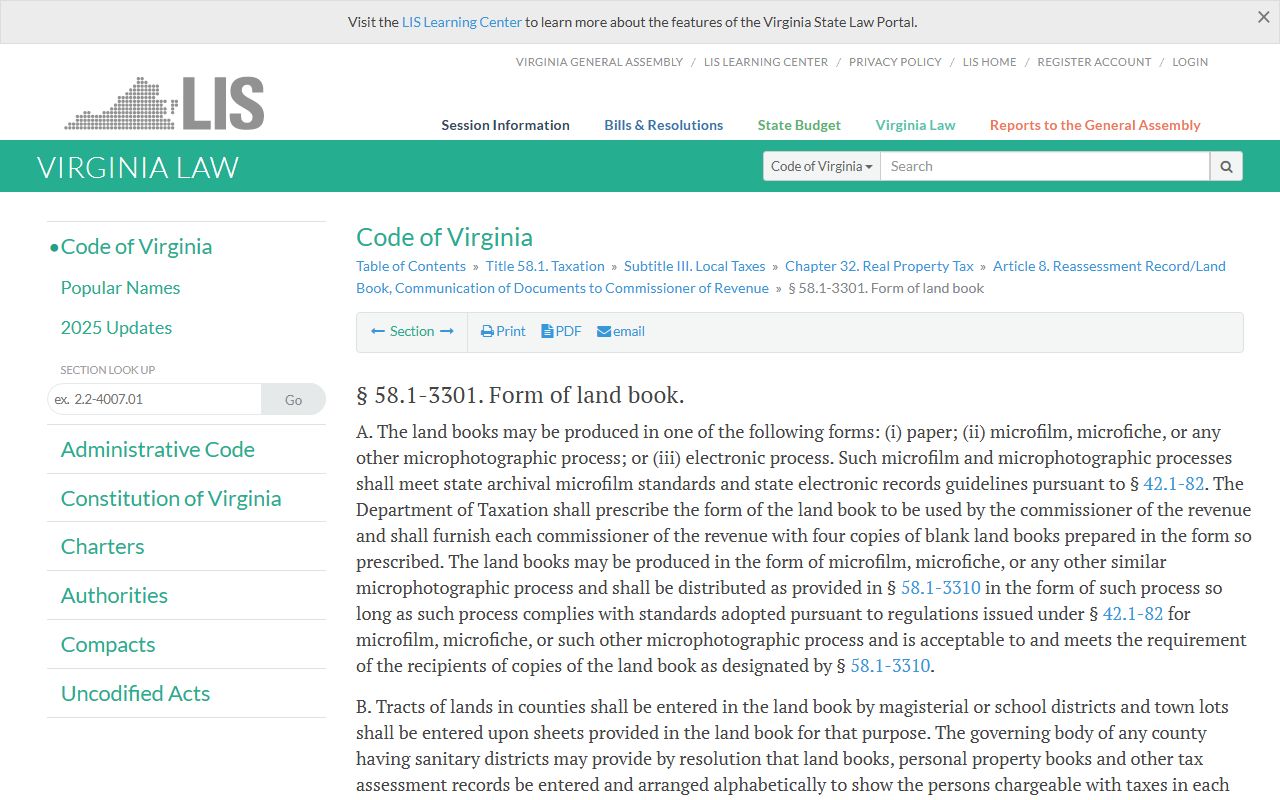
The text of § 58.1-3301 at law.lis.virginia.gov sets out what the Commissioner must maintain in the land book.
Cities in Charles City County
Charles City County has no independent cities within its boundaries. The county seat, also called Charles City, is an unincorporated community. Nearby independent cities with their own tax systems include Richmond to the west and Williamsburg to the east.
Nearby Counties
Charles City County sits along the James River between Richmond and Williamsburg, bordering several counties in eastern Virginia.