
Find Property Tax Records in Bedford County
Bedford County property tax records are maintained by the Commissioner of the Revenue and the Treasurer, both serving this central Virginia county from the county seat in Bedford. The county encompasses a mix of residential areas, Blue Ridge foothills properties, lakefront parcels around Smith Mountain Lake, agricultural land, and commercial developments. This page covers how to search Bedford County property tax records, understand the assessment process, and find tax relief programs that may apply to you.
Bedford County Overview
Commissioner of the Revenue
The Bedford County Commissioner of the Revenue is responsible for assessing all real property in the county at 100% of fair market value as required under Virginia Code § 58.1-3200. Bedford County's varied landscape creates interesting assessment challenges. Smith Mountain Lake, which spans parts of Bedford, Franklin, and Pittsylvania counties, generates a significant number of high-value waterfront parcels. These lakefront properties command premiums that must be captured accurately in assessments. Rural farms, mountain tracts, and standard residential subdivisions round out the county's property mix.
Assessment records at the Commissioner's office include the owner's name and contact address, the parcel identification number, the legal description, and the land and building values that make up the total assessed value. When deeds are recorded at the Circuit Court, ownership information in the Commissioner's files is updated. New construction triggers assessment updates after the building is inspected and an occupancy permit is issued. Major renovations and additions also lead to revised assessments in the following cycle.
The Commissioner administers tax relief programs for qualifying elderly and disabled residents and for disabled veterans. The office also handles land use assessments for agricultural and forested land that qualifies for use-value treatment. These programs require annual applications and documentation to maintain. Visit bedfordcounty.gov for contact information and to check for online resources offered by the Commissioner's office.
Under § 58.1-3330, Bedford County must send written notice when a property's assessed value changes. This notice gives property owners a chance to review the new assessment before the tax bill is generated.
Bedford County Treasurer
The Bedford County Treasurer collects real estate and personal property taxes. Tax bills are issued based on values set by the Commissioner's office. The Treasurer's office accepts payments by multiple methods, including in-person payments at the county offices in Bedford, payments by mail, and online payment options when available through the county's website.
The Treasurer maintains records of payment history and current tax status for every parcel in the county. For buyers conducting due diligence before purchasing property in Bedford County, a check with the Treasurer to confirm no outstanding taxes is a standard step. Delinquent real estate taxes are a lien on the property and transfer with the deed unless paid before or at closing. Getting a tax status confirmation from the Treasurer is a simple way to avoid inheriting a prior owner's unpaid obligations.
Overdue taxes accrue interest. Long-standing delinquencies may eventually lead to collection action, including court proceedings that can result in a tax sale. Property owners who are having trouble paying should contact the Treasurer's office to find out what options are available, whether that's a payment plan or information about relief programs through the Commissioner's office.
How to Search Bedford County Property Records
Start at bedfordcounty.gov to find the Commissioner and Treasurer department pages. Look for any online property search database that may be available. If an online tool is offered, you can typically search by parcel number, owner name, or property address to view current assessed values, property characteristics, and tax status without visiting an office.
When in-person access is needed, the Commissioner's office in Bedford is where most assessment inquiries are handled. Under Virginia Code § 58.1-3331, assessment records are open for public inspection, and you don't need a stated reason to view them. Staff can locate records by parcel number, name, or address and can print copies for a small fee. For the appraisal data underlying a specific assessment, request the appraisal card, which property owners are entitled to see under § 58.1-3332.
For deed and title records, the Bedford County Circuit Court clerk's office holds recorded instruments. Cross-referencing deeds with the Commissioner's assessment records helps build a full picture of a property's ownership and tax history. The Virginia Department of Taxation website provides background on how local assessment systems work under state law.
The image below shows the Virginia real property assessment statute that governs Bedford County's assessment standards and public record obligations.
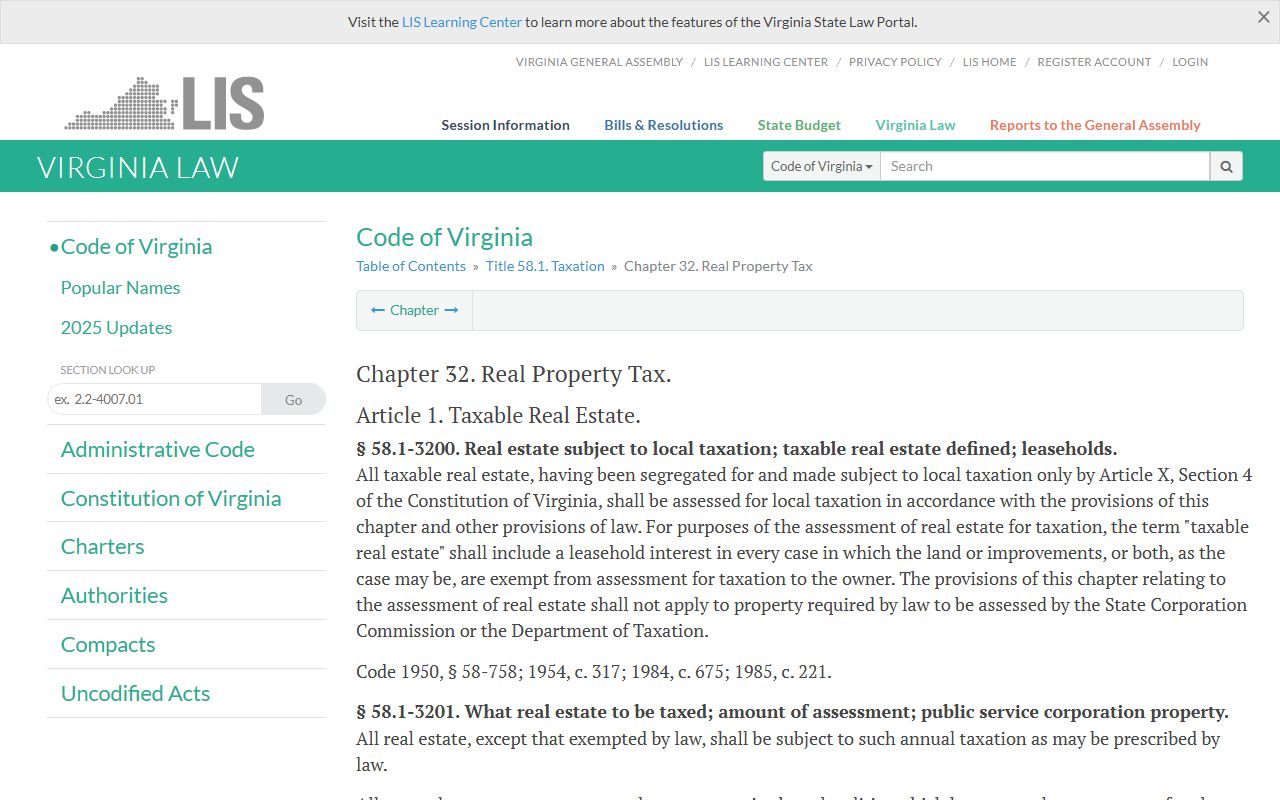
Virginia Code Chapter 32 establishes the legal framework for property tax assessment that Bedford County follows, including the 100% fair market value requirement.
Assessment Process and Appeals
Bedford County uses mass appraisal methods to assess its diverse property stock. Residential homes are compared to recent sales of similar properties in the county. Lakefront parcels around Smith Mountain Lake require analysis of waterfront sales, which have their own market dynamics distinct from inland residential sales. Rural agricultural and forested land may qualify for use-value assessment, where the productive capacity of the land sets the value rather than the open-market price. The Commissioner's office applies these different methodologies based on each property's use and characteristics.
Property owners who want to verify the data behind their assessment should request their appraisal card under § 58.1-3332. This card shows the physical characteristics the assessor has recorded, including lot size, building dimensions, year built, condition rating, and any special features. If you find errors in the card, correcting them can lead to a lower assessment without a formal appeal. Bring documentation such as a recent survey, floor plan, or photographs to support your claim of an error.
When informal correction doesn't resolve a dispute, property owners can appeal to the Board of Equalization under § 58.1-3378. This board is independent of the Commissioner and appointed by the Circuit Court. Owners present evidence at a scheduled hearing that the assessed value exceeds fair market value, and the board can adjust the value based on that evidence. Hearing procedures are governed by § 58.1-3379. Circuit Court appeal follows if the board's decision is unsatisfactory.
Tax Relief Programs
Bedford County offers real estate tax relief for qualifying elderly and disabled property owners under Virginia Code § 58.1-3210. To qualify, you must own and occupy the property as your primary residence, meet age (65 or older) or disability requirements, and fall within income and net worth limits set by the county. The benefit can be a partial reduction or a full exemption. The Commissioner's office handles applications and can provide the current thresholds, which are reviewed annually.
Veterans with total and permanent service-connected disabilities qualify for a full exemption from real estate taxes on their primary residence under § 58.1-3219.5. Surviving spouses of veterans who were killed in action or died from a service-connected disability are also eligible. You'll need a rating letter from the U.S. Department of Veterans Affairs confirming the disability. The Commissioner's office processes these applications in Bedford County.
The Virginia Department of Housing and Community Development administers state-level programs that may provide additional help for Bedford County residents facing housing cost burdens. DHCD programs can sometimes complement county-level relief options, providing a broader safety net for eligible homeowners.
The image below shows the Virginia DHCD website, which Bedford County residents can use to explore state housing assistance programs that may be available alongside local tax relief.

State programs through DHCD can help Bedford County homeowners who qualify based on income, age, disability status, or veteran status reduce their overall housing tax burden.
Land Books and Record Access
Virginia Code § 58.1-3301 requires the Commissioner of the Revenue in Bedford County to maintain a land book that lists all taxable real property, each owner's name, and the assessed value. This document is a public record open for inspection at the Commissioner's office. The land book provides a complete list of taxable parcels in the county at a given point in time and is a standard tool for title research and property due diligence.
Historical land books for Bedford County may be held at the courthouse or available through the Library of Virginia. For current records, the Commissioner's office has the most up-to-date data. The Bedford County Circuit Court clerk's office holds deeds and plats that document the legal basis for property ownership and can be cross-referenced with assessment records for a complete picture of any parcel's history.
All assessment records in Bedford County are open for public inspection under § 58.1-3331. Anyone can view them at the Commissioner's office without needing to explain why. Written FOIA requests provide a formal channel for bulk data requests or records that aren't easily retrieved through standard counter service.
Cities in Bedford County
Bedford County contains no independent cities. The county seat is the Town of Bedford, which is an incorporated town, not an independent city. Lynchburg is an independent city adjacent to the county with its own property tax system and does not have a listed city page in this directory under the Bedford County section.
Nearby Counties
Bedford County is bordered by several counties in central and southwestern Virginia. Links below lead to property tax record pages for neighboring areas.